Commonwealth City
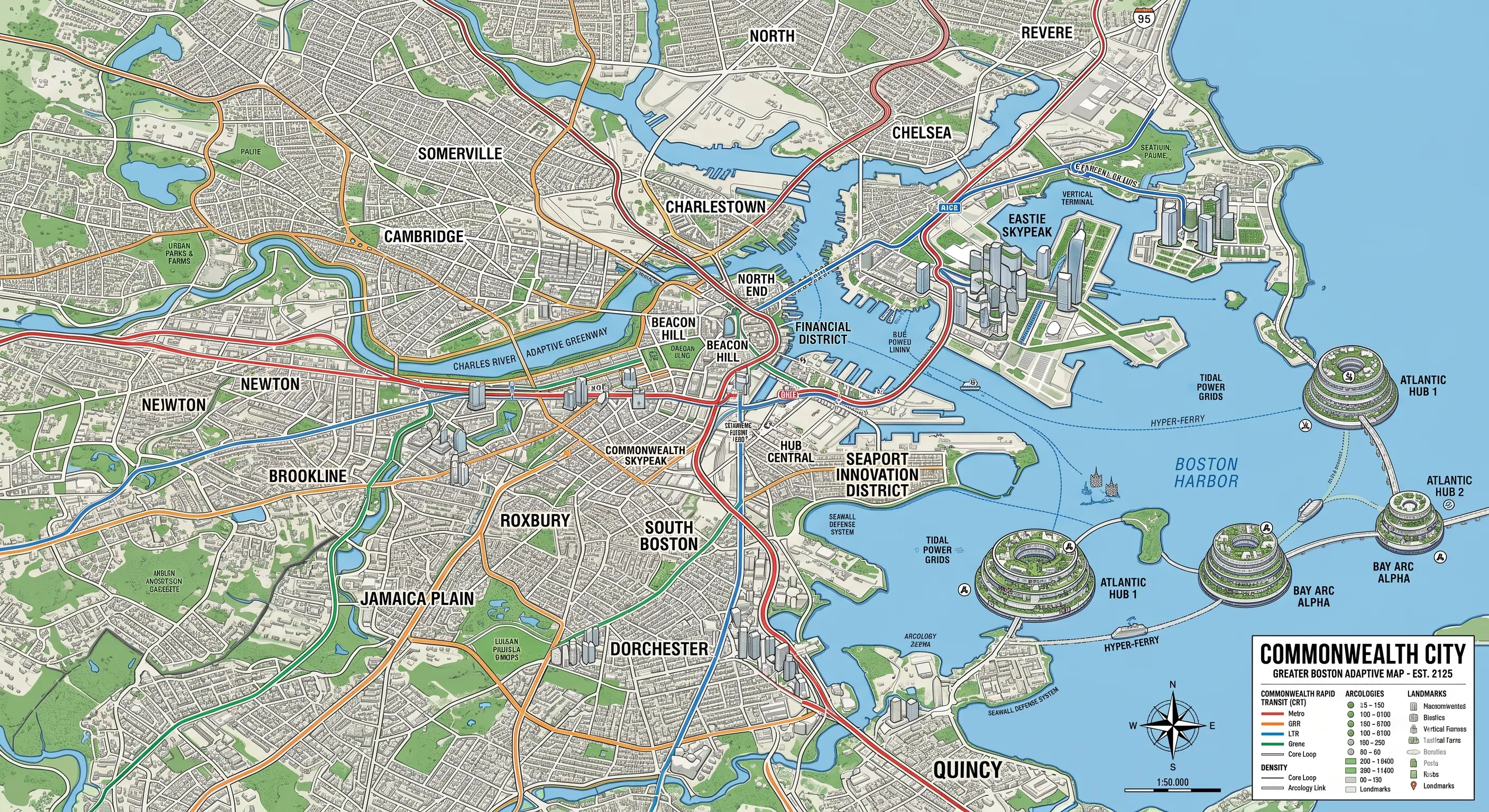
Commonwealth City is a major metropolitan city on the northeastern coast of the United States, encompassing and superseding the historical footprint of Greater Boston. Incorporated in 2011 as part of the Arcology Consolidation Act, it merged dozens of legacy municipalities into a single governed metro under a unified city charter. By 2030, it stands as one of the largest and most technologically advanced urban centers in North America, with gleaming arcologies, automated transit, and AI-managed social services.
Beneath that surface, Commonwealth City is a city of contradictions. Its lower rings house the dispossessed and the Unplugged, those who have slipped through the cracks of the Meta's optimistic architecture. Its political and corporate elite — insulated in the towers of District Apex — wield outsized influence over both the city and the world beyond. And in the shadows of the Real, supernatural factions compete for territory and survival, largely unseen by the billions plugged into the comfortable illusion above.
The city is home to Harvard University, the Commonwealth Arcology Complex, and the headquarters of several major megacorporations. It is also, by no coincidence, the operating base of the Veritas Vigil.
Etymology
The name "Commonwealth City" derives from the Commonwealth of Massachusetts, whose capital it incorporates. The informal nickname "The Hub" is an inheritance from Boston's old sobriquet, "the Hub of the Universe," coined by Oliver Wendell Holmes in the 19th century and never entirely retired. Among the Unplugged, the city is sometimes called The Stack, a reference to both the arcology towers and the layered reality of Meta over Real.
History
Pre-Consolidation Boston (Pre-2011)
Main article: History of Boston
The territory of Commonwealth City has been continuously inhabited since European colonization in the 17th century, and before that by the Massachusett people. Boston was for centuries a city of outsized historical importance — the birthplace of American revolution, a major intellectual and academic center, and a port city of considerable commercial significance.
By the early 21st century, the Greater Boston area had become a fragmented patchwork of municipalities, each with its own governance, tax base, and infrastructure. The rise of megacorporate investment, coupled with accelerating climate pressure (including chronic coastal flooding of low-lying neighborhoods), created pressure for consolidation.
Consolidation and the Arcology Era (2011–2025)
The Arcology Consolidation Act of 2011 authorized the formation of Commonwealth City as a unified municipal authority, absorbing Boston, Cambridge, Somerville, Quincy, and over thirty adjacent towns. The legislation was championed by Meridian Corp and the Helios Group, both of which had substantial stakes in arcology construction contracts.
The first arcologies broke ground in 2013. Construction of the Commonwealth Arcology Complex — a cluster of seven supertowers connected by sky bridges and transit tubes — was completed in 2022, displacing tens of thousands of residents from the Seaport and South Boston waterfront to make way for the development. Displaced residents were offered "equivalent" units in the new towers; in practice, many ended up in the lower rings, or fell off the grid entirely.
By 2025, the city had become a textbook example of Meta infrastructure: functional, gleaming, and profoundly unequal.
Commonwealth City in 2030
TODO: Recent political events, megacorporate activity, and the state of the Vigil's operations.
Geography
Location and Climate
Commonwealth City occupies the historic Greater Boston area on Massachusetts Bay, bounded roughly by the Route 128 corridor to the west and the Atlantic Ocean to the east and southeast. The city's coastline has been extensively reworked by seawall and land reclamation projects; much of the original harborfront and low-lying neighborhoods now sit beneath engineered levees and tidal barriers.
Winters are cold and snowy; summers are hot and humid. Climate shift has made nor'easters more severe and summers more extreme, but the Meta infrastructure mostly manages these conditions within comfortable parameters for residents above the lower rings.
Districts
The Waves
A series of arcologies built in the Boston Harbor, designed to withstand rising sea levels and storm surges. The Waves are primarily residential, with some commercial and recreational spaces, and are connected to the mainland by a network of tunnels and bridges. Home to over 100,000 of the city's wealthiest residents, the Waves are a symbol of modern security and luxury, but also a stark reminder of the climate crisis that necessitated their construction.
Logan
Once the site of an international airport, Logan was devastated by a dirty bomb attack in the late 2000s, and was subsequently decommissioned and redeveloped after extensive Superfund cleanup efforts. Today, it is a district of high-rise residential and commercial buildings, with passengers of the nearby Commonwealth Citiy International Airport in Fort Devens, arriving via maglev transit to stations in Logan, as well as the Waves and other major districts.
Cambridge
Home to the Massachusetts Institute of Technology and Harvard University, Cambridge is the intellectual heart of the city, with a dense concentration of research institutions, startups, and think tanks. The district is a hub for innovation and academia, but also a flashpoint for gentrification and displacement, as the demand for housing and commercial space has driven up prices and pushed out long-time residents. Despite urban densification in the downtown regions, Cambridge remains stubbornly suburban, with sky-high rents and single-family homes only overpaid professors can afford.
Thanks to the integration of both schools under the Commonwealth City Education Charter, matriculated students enjoy free room and board while their studies last, but those who drop out or graduate find themselves quickly priced out of the district, and many end up in the Seams or the Lowers.
Southie
The South Boston waterfront was the original site of the Commonwealth Arcology Complex, and was the first district to be redeveloped under the Arcology Consolidation Act. The construction of the arcologies displaced tens of thousands of residents, many of whom were offered "equivalent" units in the new towers, but in practice, many ended up in the lower rings, or fell off the grid entirely. The district is now a mix of high-rise residential and commercial buildings, with a focus on tech companies and luxury housing. It is also home to several major cultural institutions, including the Boston Symphony Orchestra and the Museum of Fine Arts.
Old Town
The historic North End, as well as the adjacent Charlestown and East Boston neighborhoods, have changed relatively little since the consolidation, and are now collectively known as Old Town. The district is a mix of residential and commercial areas, with a strong Italian-American heritage and a vibrant food scene. It is also home to several major landmarks, including the Paul Revere House and the Bunker Hill Monument.
Locals argue whether the Back Bay counts as "Old Town" or not, but it too is little changed, with its iconic brownstones and high-end shopping district remaining intact, albeit with a growing number of empty storefronts as the retail industry continues to contract.
Government
Commonwealth City operates under a Strong Mayor system, with an elected City Council providing legislative oversight. In practice, the Commonwealth City Development Authority — a quasi-public body with deep ties to Meridian Corp — holds significant de facto control over zoning, infrastructure, and development contracts.
The Technocracy maintains a discreet operational presence within city government, primarily through embedded personnel in the Commonwealth Security Bureau and the city's AI management systems.
TODO: Mayor, key council factions, recent elections.
Economy
Commonwealth City is one of the largest economic centers in North America. Key sectors include:
- Technology and AI: Home to several major AI development labs, including those operated by Meridian Corp and Helios Group.
- Biotechnology and Medicine: The Boston Medical Corridor remains a global leader in genetic research and biotech, with a growing presence of companies operating at the edge of legal and ethical bounds.
- Education: Harvard, MIT (now Commonwealth Technical Institute), and dozens of smaller institutions anchor a robust knowledge economy.
- Finance: Commonwealth City hosts the Eastern Exchange, the largest carbon-credit and computational futures market in the hemisphere.
- Grey Market: A substantial informal economy exists in the Lowers and Seams, trading in everything from unregistered biotech to Real-world artifacts.
Demographics
TODO: Population breakdown, notable communities (Unplugged population, supernatural factions in the Real).
Notable Institutions
| Institution | District | Notes |
|---|---|---|
| Harvard University | Apex | Oldest continuously operating university in North America |
| Commonwealth Arcology Complex | Apex / Midtown | Seven-tower arcology; city landmark |
| Commonwealth Security Bureau | Midtown | City law enforcement; Technocracy-adjacent |
| Meridian Corp HQ | Apex | Largest megacorporate employer in the city |
| Helios Group Tower | Apex | Second-largest arcology developer in North America |
| Veritas Vigil HQ | Seams | Secret; location unknown to most |
In the Real
In the Real, Commonwealth City is a city in a state of managed decay. The arcology towers exist — they are physical structures — but they are dark, partially occupied, and crumbling at the margins. The gleaming surfaces of the Meta give way to exposed rebar, mold, and deferred maintenance. The streets below are largely empty of the Meta's managed foot traffic.
The Real city is divided between several competing supernatural factions:
- The Court of the Long Night (vampires) holds the Midtown corridors and much of the Apex sublevels, which they use as a hunting ground by night.
- The Unseelie Compact (fae) controls a significant portion of the Lowers and the remnant green spaces.
- The Sentinels of the Pack (werewolves) patrol the outer districts and former suburbs, serving as a buffer between human Unplugged settlements and encroaching Influx horrors.
- The Fallen maintain a number of safe houses throughout the city and serve as reluctant allies to the Vigil.