Kalidnay, the City Reborn
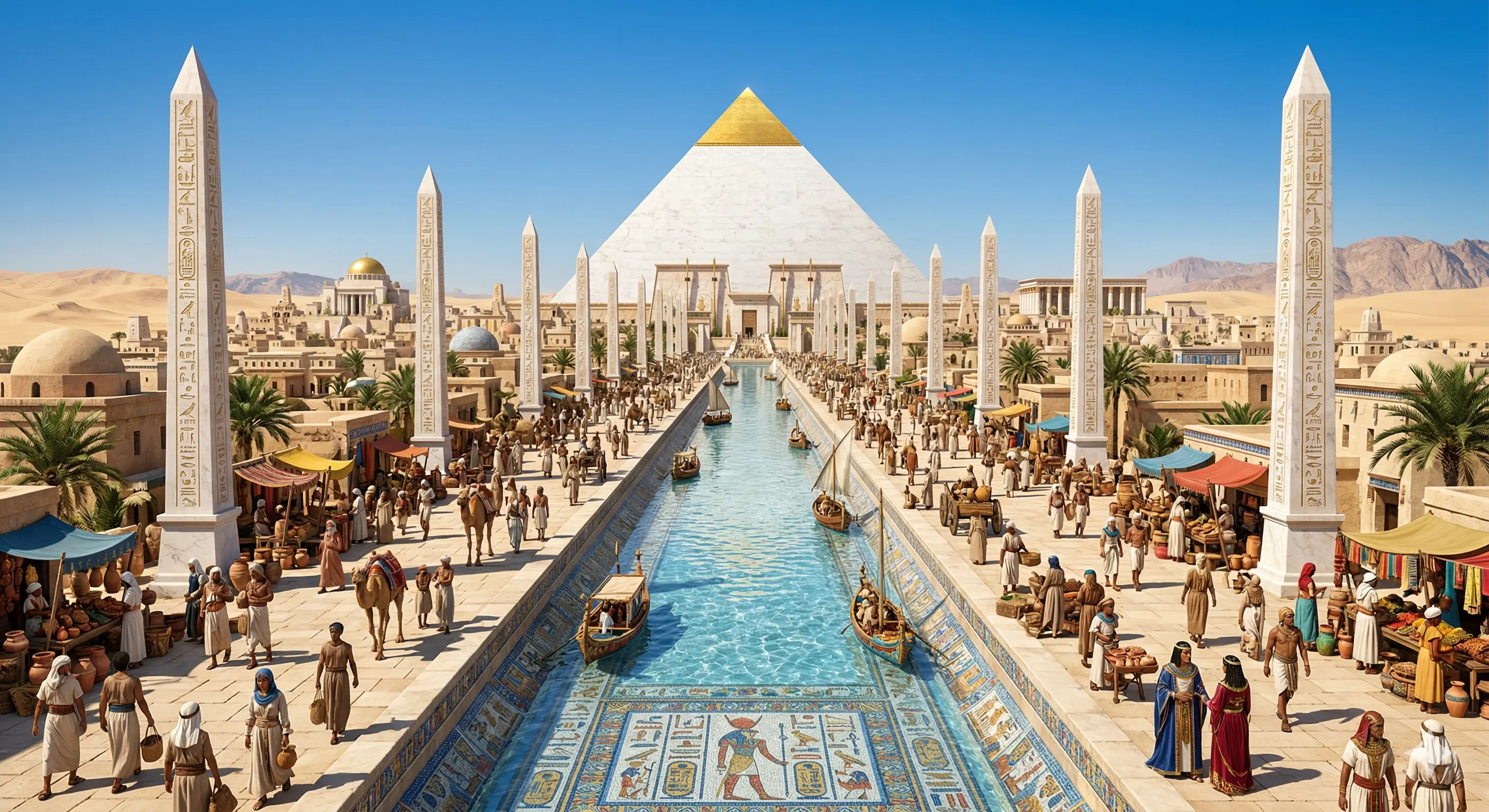
Kalidnay, known as the City Reborn, is a prominent city-state located south of Tyr in the Tablelands. It was originally founded in antiquity by Kalid-ma, one of the Champions of Rajaat, as a center for grain production and a bastion of his power. When an unexplained arcane catastrophe caused everyone in the city to vanish, the city was quickly looted and fell into ruin. In the intervening centuries, Kalid-ma's daughter, Ka-Tet, has led a campaign to rebuild Kalidnay as a thriving city-state under her rule. In recent decades, the city itself has been rebuilt, and the population has flourished in recent years, with a sort of "grand opening" occuring in Free Year 10 as Ka-Tet has invited dignitaries from across the Tablelands to witness the city's rebirth.
Etymology
Kalidnay's name is derived from its founder, Kalid-ma. The suffix "-nay" is an ancient Athasian term meaning "city" or "place of," so the name can be translated as "City of Kalid-ma." The name was retained even after the city's destruction and subsequent rebuilding, as a tribute to its origins and the legacy of its founder.
History
Main article: History of Kalidnay
Kalid-ma founded the city during the Green Age, while conducting warfare at Rajaat's behest. The city flourished under her rule, becoming a center of commerce and agriculture in the region. As the war entered its later stages, Kalid-ma was among those second-guessing Rajaat's campaign, and she gradually withdrew her forces from his war, and ultimately stood against him in the final confrontation. With Rajaat imprisoned, Kalid-ma could focus on ruling her realm.
For over 1,600 years, she ruled as a wise and powerful sorcerer-queen, establishing a haven of greenery and fertility in the harsh desert. However, her reign came to an abrupt end when an arcane catastrophe caused everyone in the city to vanish without a trace. The city was quickly looted and fell into ruin, becoming a desolate wasteland.
Her daughter, Ka-Tet, has led a campaign to rebuild Kalidnay as a thriving city-state under her rule. It took centuries to build up her remaining exclave of Last Oasis, but from that base, she was able to gather the resources to retake and rebuild the city, and in recent decades, she has repopulated it. It's been only a year since the city was fully open to foreigners, and today, at the 300th anniversary of Kalid-ma's disappearance, Ka-Tet has invited dignitaries from across the Tablelands to witness the city's rebirth, and to establish diplomatic and trade relations with the other city-states.
Geography
Location and Climate
In the Green Age, the now-dry Kamat River expanded into a delta in this region, where it met the Obsidian Sea. The city was built on the fertile flood plains of the delta, with canals and irrigation systems drawing water from the river to sustain agriculture. The surrounding area was lush and green, with abundant wildlife and vegetation.
Now, the river and the sea are gone, with only a small oasis remaining a few dozen miles from the city proper. Last Oasis' aquifer has been protected by Ka-Tet's magic, while in the past, the entire floodplain was kept fertile by her more powerful mother. Much of the work done in the last century has been focused on expanding water flow from Last Oasis to the city, and expanding Ka-Tet's magical control of it.
Today, the city boasts an impressive, audacious open-channel irrigation system that draws water from underground aquifers and the Last Oasis, distributing it throughout the city and surrounding farmland. The city is surrounded by a moat filled with water from the oasis, providing both defense and a source of irrigation. Ka-Tet's magic keeps the city's water pure, cool, and shielded from the sun. Evaporation is almost zero, and the city reclaims all its lost moisture through a sophisticated, newly-built sewer system reminiscent of Tyr's more ancient one.
The influence of Ka-Tet's magic can only extend so far, though, and barely an acre field's width from the nearest canal, the land quickly reverts to arid desert. The surrounding environment is almost entirely barren, with smooth sand and silt blown into shallow dunes by the wind. The silt is sediment from the Obsidian Sea, blown over the former farmland by the wind over the centuries. The sediment is quite fertile, but without irrigation, it cannot support crops. The city is a green oasis in the middle of a vast desert.
City Layout
Kalidnay's roads are laid out with geometric perfection, all radiating out from the central pyramid. One central road boasts a canal running down its middle; this Grand Promenade connects the north and south gates of the city, with the pyramid at its center.
The canal literally and symbolically divides the city along lines that run deep through its history and culture. The clergy owns the eastern half, and the nobility own the western half. Commoners and merchants rent homes and workspaces in both halves, but the division is still quite pronounced. The east city has unified laws and culture, administrated by a clergy class unified under the state religion of Kalid-ma. The west city is more fragmented, with various noble families controlling different districts, each with their own customs and laws.
The city can be further subdivided in terms of distance from the central pyramid. The closest districts are the most prestigious: government buildings and foremost noble houses on the west, and grand temples and rectories for the ruling clergy on the east. In the west, further districts are generally held by lower-ranked, less wealthy noble families, while in the east, different methodology is applied, with each district being dedicated to a different Avatar--the demi-deities in Kalid-Ma's service. They are numerous, and have a complex hierarchy, which is reflected in the city's design.
Merchants and tradesmen tend to cling to the boulevards--especially the Grand Promenade--where foot traffic is highest, while commoners tend to live where they can, mostly clustering in the "voids" between the boulevards at the furthest extent of the city, where travel to the center takes longest. The city is quite limited in land area, so commoners tend to live in tall, cramped apartments and tenements. Merchants and tradesmen enjoy reasonably spacious townhomes in proximity to their workplaces, and nobles have vast, luxurious estates with gardens and multiple structues.
The Pyramid
The Great Pyramid of Kalidnay is the city's most iconic landmark, dominating the skyline from every vantage point. It serves as the seat of power for Pharaoh Ka-Tet and the ruling clergy, as well as a grand temple dedicated to Kalid-ma. The pyramid is an architectural marvel, with its smooth, polished stone surfaces and intricate carvings depicting the history and mythology of Kalid-ma and her city.
The Grand Promenade cuts right through the structure, delivering people directly into its interior. The pyramid has dozens of floors, but the lowest are largest, with Ka-Tet's throne room and the main temple on the first floor, and the upper floors housing offices and meeting rooms for governing officials and ruling clergy. The highest level, just below the golden cap, is Ka-Tet's private quarters, utterly forbidden to anyone she doesn't personally invite.
There are several levels below as well, including dungeons, vaults, armories, and war rooms. Some say Ka-Tet has a spellcasting chamber in the depths, other say it's within the golden cap itself, but don't believe anyone who claims to have seen it.
The Temple of Kalid-ma
Just beside the pyramid, directly east, stands the grand Temple of Kalid-ma, the largest and most ornate temple in the city. It serves as the spiritual center of Kalidnay and is dedicated to the worship of Kalid-ma, the city's patron goddess. The temple is a sprawling complex with multiple courtyards, shrines, and sanctuaries, each dedicated to different aspects of Kalid-ma's divine portfolio.
The massive temple is capable of hosting literally the entire city's population in its main courtyard, and it does so regularly for festivals and ceremonies. The temple is also the headquarters of the clergy, who wield significant political power in the city. The high priestess of Kalid-ma is second only to Pharaoh Ka-Tet in terms of influence and authority. The temple is also a center of learning and scholarship, with a vast library containing ancient texts and knowledge about Kalid-ma, her avatars, and the history of the city--accessible only to the faithful, of course.
Demographics
Ka-tet has been eager to populate her city. So eager, that she has purchased and conquered slaves from across the Tablelands, putting them to work building her city's glory. As such, the city has the highest percentage of slaves of any city in the Tablelands, and the population is quite diverse, with people from all over the region.
Racial Composition
| Race | Percentage | Notes |
|---|---|---|
| Humans | 75% | Dominant as a broad category, but drawn from many different regions and cultures |
| Ashkari | 9% | Nomads largely brought in as slaves |
| Muls | 5% | Prized for their physical prowess, the vast majority are slaves |
| Illari | 3% | Somewhat less likely to be enslaved, many Illari are traders and artisans in the city |
| Dwarves | 2% | Largely a pair of dwarven noble houses who were essential in rebuilding the city |
| Thri-kreen | 1% | Mostly free, many are traders who set up a permanent presence |
| Other | 5% | Halflings, pterrans, etc. |
Social Classes
| Class | Percentage | Notes |
|---|---|---|
| Clergy | 10% | An extremely large proportion compared to most cities, they serve as the bureacratic and administrative class, as well as educators, healers, and even agricultural directors. |
| Nobility | 5% | The noble class is quite small, with only a few dozen noble families, but they wield significant influence and wealth. |
| Tradesmen and Merchants | 5% | A growing middle class of skilled workers, artisans, and traders who are essential to the city's economy. |
| Freemen | 10% | Free citizens who are not part of the clergy or nobility, including many former slaves who have earned their freedom. |
| Slaves | 70% | The largest and most diverse class, slaves in Kalidnay come from all over the Tablelands and are used for a wide variety of labor, from agricultural work to construction to domestic service |
There is no notable population of incarcerated criminals in the city, as most are sentenced to death or enslavement. Foreigners are also not counted in the population, as they are not citizens and have to pay for the right to remain in the city, so they are generally transient and not included in official statistics. However, in Free Year 10, Ka-Tet announced a change in policy, allowing long-term residence of foreigners in certain districts--a contraversial move that has been met with both excitement and skepticism by the city's residents.
Economy
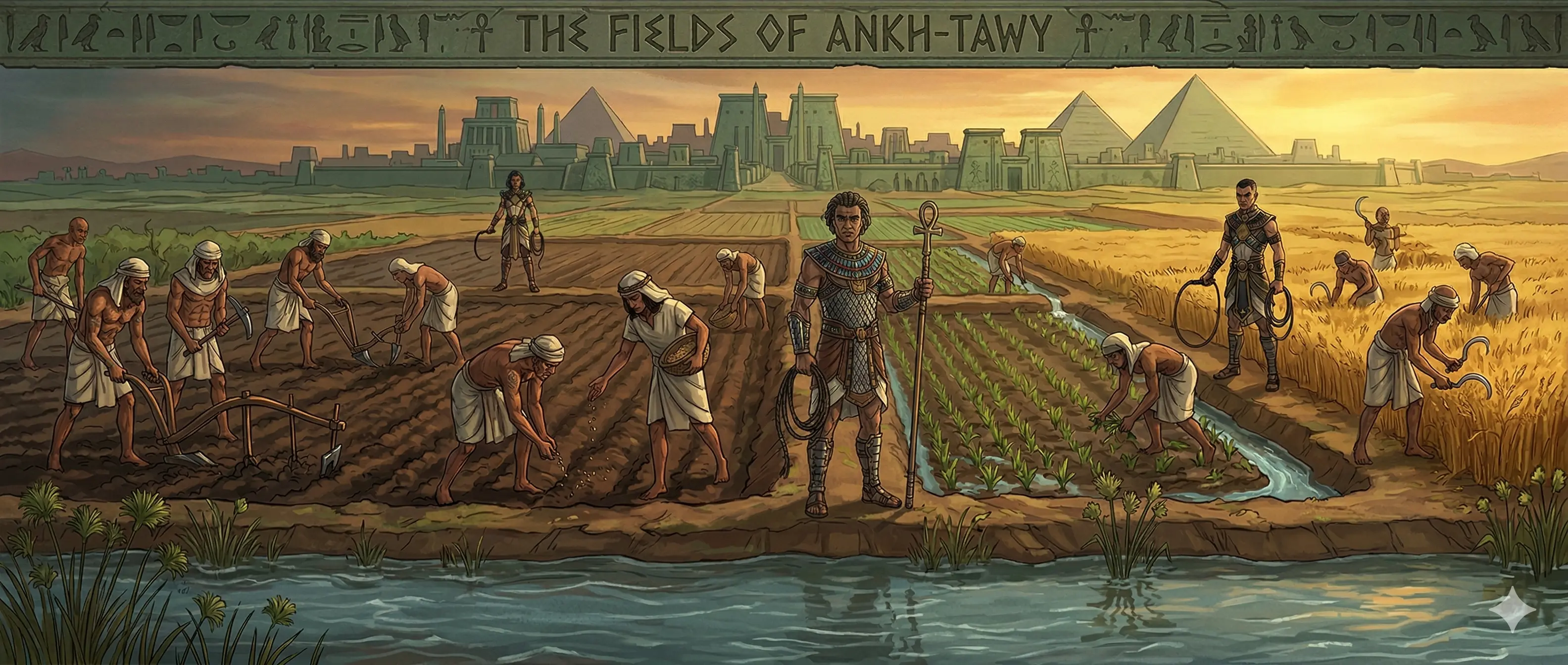
Slaves till the soil, sow the seeds, and reap the harvest while overseers cruelly direct them
The lifeblood of Kalidnay's economy is agriculture. The city's location on the former fertile flood plains gives it rich soil for the cultivation of crops of every sort, provided the Pharaoh can bring the water needed to irrigate them. Many fruits and spices grow here, but the dominant crops are faro grain and kank honey, which are exported across the Tablelands in large quantities. The city also produces a significant amount of erdlu eggs, which are prized for their nutritional value and unique flavor.
The city's farmers are almost entirely slaves, who toil under the harsh supervision of overseers. The agricultural sector is highly organized and efficient, managed directly by the clergy, who claim their prayers tell them what to plant and when. To their credit, they enforce a strict system of equity, where all citizens in good standing are guaranteed a living share of the harvest in return for work. No free man goes hungry in Kalidnay, unless he refuses to work--a rare choice quickly leading to slavery.
With the clergy's guidance, the grain harvest is rigorously accounted for, and crop yields form the basis of the city's economy. Like Tyr, the city's primary currency is pegged to the value of grain, specifically a day's grain allowance for a common laborer. Naturally, this can produce seasonal variation in the currency's value, but the clergy has implemented a system of grain storage and release to stabilize it as much as possible. Still, that variance is happily seized upon by traders and speculators, who attempt to exploit it for profit.
Trade
As a new city, and among the smaller ones in the Tablelands, Kalidnay is not a major hub of trade, but it has been growing steadily in recent years. The city has much to offer, especially its agricultural products, and it has been exporting them to other cities in exchange for goods it cannot produce itself, such as iron, wood, and luxury items.
In an effort to boost trade, Ka-Tet has recently opened the city to foreigners, allowing them to establish a permanent presence in certain districts. This has led to an influx of merchants and traders from across the Tablelands, eager to tap into the city's resources and market. The Grand Promenade has become a bustling center of commerce, with shops, markets, and trading posts lining its length. The deeply traditional and insular nature of the city has made this transition somewhat rocky, especially among the clergy, whose dogma holds that Kalid-ma is the beginning and end of the city's provenance, and no foreigners should be allowed to influence the city or its culture. Some hardliners even suggest total isolation from the outside world, but Ka-Tet has been firm in her vision of a more open and interconnected city, and she has the power to enforce it.
Merchant Houses
While there is a small but thriving merchant class, major trade is dominated by noble houses, who have the resources and connections to manage large-scale trade operations.
(list of major merchant houses, their specialties, and their influence in the city)
Currency
Like all Athasian city-states, Tyr uses ceramic pieces as currency. These fired clay coins are stamped with the city's seal on the obverse--a stylized image of the Great Pyramid, radiating light--and the image of Kalid-ma on the reverse, depicted as a regal figure with a crown of grain and a scepter of water. The coins are, locally, pegged to the value of grain, but generally accepted as equal to Tyran ceramic pieces.
Silver and even gold coins are minted for high-value transactions, but these are less often used than bullion, which is weighed rather than counted. The city's merchants and nobles often prefer to conduct large transactions in bullion, as it is more portable and less prone to counterfeiting than ceramic pieces.
Culture
Religion
Worship of Kalid-ma is the state religion, and the city's culture is deeply intertwined with her mythology and teachings. The clergy wields significant influence over all aspects of life in Kalidnay, from politics to education to agriculture. The city's festivals and ceremonies are centered around Kalid-ma, with grand celebrations held on the anniversaries of her birth, ascension, and disappearance (and ascension).
Kalidnay has a public education system, boasting one of the highest literacy rates in the Tablelands (among freemen, anyway). The curriculum is heavily focused on the teachings of Kalid-ma, as well as practical skills for managing the city's agriculture and bureaucracy. The clergy runs the schools, and they are quite strict about the content taught, ensuring that it aligns with their dogma and reinforces their authority.
Religious laws dictate which foods can be eaten, how people should dress, and even how they should interact with one another. For example, the consumption of meat is heavily regulated, with only certain animals deemed "clean" and permissible to eat. Most famously, the clergy forbids the consumption of alcohol, which they claim is a defiling substance that clouds the mind and weakens the body. Concerns about the safety of drinking water are allayed, as the magic of the Pharaoh (or, by church dogma, her mother) keeps the city's water pure and refreshing, so there is no need for alcohol as a safer alternative. Notably, this restriction is for citizens only, so the increasing foreign presence in the city has led to a thriving black market for alcohol, which is smuggled in from other cities and sold at high prices to those who can afford it.
Women and Girls
For a city-state so heavily invested in slavery, Kalidnay is surprisingly progressive when it comes to the rights of women and girls. Sexual crimes are punished severely, and the victim is never blamed or punished. Women have the right to refuse suitors, and even to refuse sexual relations with their own husbands. Women have the right to own property, conduct business, and participate in politics. In fact, many of the city's most powerful and influential figures are women, especially among the clergy: only women can be priestesses, while men can be templars, who have an important role as enforcers, but do not make administrative decisions.
These rights are directly proportional to class, sadly. Laying a finger on the daughter of a priestess carries the harshest punishments imaginable, but a free woman may face scrutiny when accusing a noble's son of assault, with a high bar for evidence. Slaves have the least rights of all, but even they are protected to some extent. All slaves have to have a declared profession, and it must be something valid like farming, construction, or domestic service--not prostitution. Of course, few will stick out their necks to report a rich merchant or noble slave owner for forcing their slave women into "extra-curricular activities,", but on the rare occasions when they do, the city has a strong track record of prosecuting those cases to the fullest extent of the law, and the clergy has made a point of publicizing those cases to deter future abuse.
Prostitution is not illegal as such, but it is also not a path open to free women. A branch of the priesthood operates sanctioned brothels, in a form of "sacred prostitution," where trained priestesses serve as "companions" to clients, providing not only sexual services but also companionship and spiritual guidance. This is seen as a form of outreach, to spread the gospel and teachings of the church in a manner that reaches certain ears better than others. Kalid-ma is the goddess of all, and includes fertility, sexuality, and family in her portfolio, and the Companions are seen as an important part of the church's mission to spread and reinforce her dogma. The Companions are highly respected within the church, and they receive extensive training in both their spiritual duties and their practical skills, such as conversation, etiquette, and even combat, to protect themselves from unruly clients. Unlike ordinary prostitutes, Companions always have final say over any and all activities they perform, and with whom.
Gladiatorial Games
It wouldn't be an Athasian city without gladiatorial games, and Kalidnay is no exception. The city boasts a modestly-grand arena, capable of seating most of the city's population, where gladiators fight for the entertainment of the masses. The games are held regularly, with different themes and matchups to keep things interesting.
An important distinction is that, unlike most cities, no slaves are forced to fight. The arena is for freemen only. Every game is sanctioned by the church, and the gladiators are seen as champions of Kalid-ma, who fight not just for glory and prize money, but also to demonstrate the strength and resilience of the city's people. Battles can be trials by combat, which have judicial finality, trials of liberation, which can free slaves who win, or trials of honor, in which warriors take on dangerous beasts or other formidable opponents to earn the blessings of Kalid-ma (which can be both spiritual and monetary).
Foreigners are allowed to compete in the games, and this helped keep them functioning before Ka-Tet opened the city, since there just weren't all that many freemen willing to risk death for sport. Now, with the city's population booming, the games have become more competitive than ever, and the level of skill on display has skyrocketed. The arena has become a melting pot of cultures and fighting styles, with gladiators from all over the Tablelands coming to test their mettle against the best in Kalidnay.
Government and Politics
The government of Kalidnay is a balancing act between an extremely powerful clergy class, and a wealthy but small noble class, with the Pharaoh attempting to bridge the gap. Ka-Tet is the daughter of the goddess, and is therefore both the rightful queen and the most divine living being in the city. Technically, she has the highest position in both the nobility and the clergy, but in practice, she has to navigate the complex power dynamics between the two classes, as well as the interests of the commoners and merchants.
A Tale of Two Cities
Modern Kalidnay is a tree grown from a seed, and that seed was planted centuries ago. Ka-Tet was young when her mother faded from this world--hardly the master sorceress and political prodigy she is today. She survived her mother's downfall not from magical power or great foresight, but from luck--she just wasn't there. Her mother had sent her to Last Oasis for magical training, and though she may have done so in part out of concern for the consequences of her ill-fated ritual, she didn't prime her daughter for a career as her successor. The royal household in Last Oasis was sufficient to train a girl in magic and courtly etiquette, but it was not equipped to prepare her for the task of rebuilding a city-state from the ground up.
When the city fell, its backbone was broken. While thousands of citizens still existed in the surrounding region, they were scattered and disorganized, and there was no unifying, central authority to rally around. While today there are great noble houses with generations of history, the only thread reaching that far back is the furtive, early cult of Kalid-ma. With such a powerful figure dying--nay, vanishing--in such a mysterious and dramatic way, there was inevitably a cult following, at first focused on her inevitable return, then shifting gradually to believing she'd already ascended to godhood.
The city never would have been reborn without the clergy. Ka-Tet played into their myths and stories, accepting a role as "chosen one" and living heir to her mother's glory, while also realizing that a city-state needs feet on the ground, bricks on the wall, and farmers in the field. The church focused on prophecies of magical deliverance, while Ka-Tet focused on the practicalities of building a city. She couldn't possibly have built a governmental apparatus without them, so she made a compromise: one that has defined the city's politics ever since.
As a result, the clergy can claim three centuries of continuity, funding and physically staffing the majority of the history of the city's eventual rebirth. The secular population largely came later, with individuals and families roped in one-by-one by Ka-Tet's brilliant social engineering. Not one of the city's modern leading noble families can trace their lineage convincingly back to the age of Kalid-ma, but their resources were vital to rebuilding the city.
As a result, the nobles generally feel they are entitled to the spoils of the city's success, and ought to form the entirety of the governmental structure underneath Ka-Tet, while the clergy believe they are the rightful rulers of the city, and that the nobles are just parasites who should be kept in check. Ka-Tet has to walk a tightrope between these two factions, ensuring that neither feels too slighted, while also maintaining her own authority and vision for the city.
A Bicameral Legislature
Ka-Tet is Pharaoh, ruling with the divine mandate of her mother, the True Goddess of the city. One would think she has absolute authority, but in practice, her power is checked by the two most powerful institutions in the city: the clergy and the nobility.
A more naive ruler might have let this play out in her council, as priestesses and nobles whisper in her ear during soirees and banquets, but Ka-Tet is a shrewd political operator, and she has institutionalized this balance of power in the form of a bicameral legislature. The city has two legislative bodies: the Council of Priestesses, which represents the clergy, and the Assembly of Nobles, which represents the noble families. Both bodies have significant influence over the city's laws and policies, and they often have competing interests and agendas.
Between these two bodies, and her royal and divine self, there is a three-way vote that can decide any major policy or law. Ka-Tet's voice counts as much as either body, but not both, so if both agree, she will abide by their decision, but if they disagree, she has the power to break the tie. This system has allowed her to maintain a delicate balance of power, while also ensuring that she has the final say when it matters most. Technically, she can override an agreement between the two bodies, but doing so would be politically risky, as it would alienate both factions and potentially lead to unrest or even rebellion. To date, she has not exercised this power.
Power and Privilege
Both the nobles and clergy expect and demand privilege in payment for their power. Both have several privileged in common: the right to be tried only by their peers or the Pharaoh, the right to permanently own property in their names, and the right to investigate and prosecute crimes without interference from the other faction.
Some powers, importantly, are distinct to one or the other faction. The clergy is allowed an armed unit--the Templars--who are the top-tier enforcers of the city's laws, and they are also the only ones allowed to carry out executions. The nobles, on the other hand, have the right to maintain actual armies, who form the bulk of the city's defenses and fighting forces.
The clergy is well funded by a universal 10% tithe from all citizens, but the nobles can levy arbitrary and complex taxes on their subjects, and some have even greater wealth than their clergy equivalents as a result.
While nobility generally own most productive land in other city-states, by law and tradition, all agriculture in Kalidnay is owned and managed by the clergy. That said, the clergy's influence begins and ends at the city limits, so the nobles have found their niche with foreign trade. Grain beyond the minimum needed to feed the city is allowed to be sold privately, with nobles paying the city itself, then commanding whatever price they can abroad.
As the newly open city attracts foreign traders, clergy worry that the delicate balance will soon tip in favor of the nobles, who can profit from the influx of wealth and influence, while the clergy's power is more static, tied to the city's population and land. Ka-Tet has been trying to assuage these concerns by ensuring that the clergy receives a significant share of the profits from trade, but it's an ongoing struggle to maintain the balance.
Political Factions
While the classic nobility-vs-clergy dominates the city's politics, there are several smaller factions that have their own agendas and influence, many of which are growing rapidly. Notable factions include:
- The Solarians: while Kalid-ma's faith emphasizes the sun as a symbol of life and growth, there is a small but vocal faction within the clergy that worships the sun itself as a separate deity. They believe that the sun is the true source of life and power, and that Kalid-ma is just a servant or avatar of the sun. They advocate for more solar imagery and rituals in the city's culture, and they have been pushing for a solar temple to be built on the Grand Promenade.
- The Isolationists: a faction within the clergy that opposes Ka-Tet's policy of opening the city to foreigners. They believe that Kalidnay should be a pure, self-sufficient city-state, free from outside influence and corruption. They have been vocal in their opposition to foreign traders and residents, and they have been pushing for stricter immigration and trade policies.
- The Progressives: a faction within the nobility that supports Ka-Tet's vision of a more open and interconnected city. They believe that trade and cultural exchange with other cities is essential for Kalidnay's growth and prosperity, and they have been advocating for policies that encourage foreign investment and residency. They have also been pushing for reforms to the city's laws and institutions to make them more inclusive and adaptable to change; most notably, a Tyr-inspired reconsideration of the institution of slavery.
Notable People
- Pharaoh Ka-Tet: the current ruler of Kalidnay, daughter of Kalid-ma, and the driving force behind the city's rebirth. A shrewd political operator and powerful sorceress, she has navigated the complex power dynamics of the city to maintain her authority and vision for its future.
- High Priestess Amonet: the current high priestess of Kalid-ma, and second in power only to Ka-Tet. She is a devout and influential figure within the clergy, known for her strict adherence to doctrine and her ability to sway public opinion.
- Lord Seti: a prominent noble and head of one of the city's most influential families. He is a vocal supporter of Ka-Tet's policies and has been instrumental in securing foreign investment and trade for the city, but he is also known for his ruthless business practices and his willingness to use his wealth and influence to get what he wants.
- Lady Aria: a rising star in the city's political scene, Lady Aria is a young noblewoman who has been gaining popularity among the commoners for her advocacy of social reforms and her efforts to improve the lives of the city's freemen and slaves. She is seen as a potential future leader of the city, and her influence is growing rapidly.