The Emberwaste
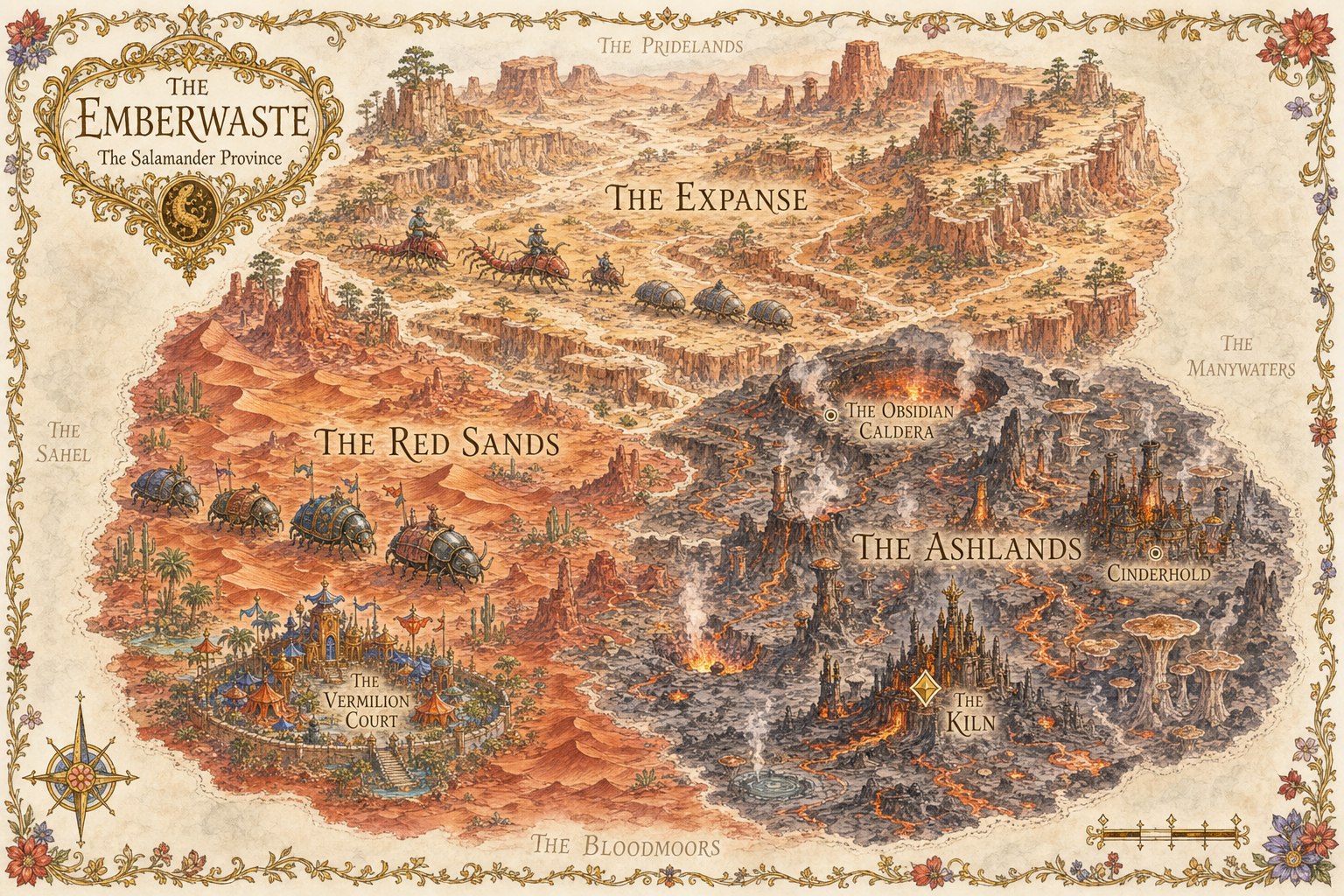
A desert of red sand and black glass, cut by canyons and studded with vents that breathe fire on their own schedule. Nothing here is abundant except heat. The Salamanders hold it, and hold it badly — they are perpetually at war with one another over the few springs, shaded canyons, and workable glass-fields, and the Kingdom quietly encourages this, since a united Salamander host would be the most dangerous army in the world.
The Land
Sand, glass, and canyon, with the vent-fields shifting on a scale of decades. Water exists in a countable number of places, all of which have changed hands violently within living memory.
Sand at Faerie scale is not sand; it is a country of loose boulders. A dune face is a rockslide waiting for a footfall, travel is done along wind-packed ridges and canyon floors, and the deep sand — the soft, flowing, hundred-foot-deep interior — is simply not crossed. It belongs to the people who swim in it.
- The heat. Midday surface temperature on the black glass will kill any Faerie but a Salamander in under an hour, and will kill a Salamander too, given two. All travel is dawn and dusk. All settlements are shaded, buried, or both.
- Vent-fall. The fire vents breathe on their own schedule, and the schedule is known — a Salamander child can recite the local sequence — but the field itself migrates over decades. Every generation, some settlement discovers it has been built in the path of something.
- Glass storms. Wind across the black glass fields shears off flakes, and a glass storm strips paint, hide, wings, and eyes. The warning is a smell like hot pennies, about ninety seconds beforehand.
- Nightcold. After dark the desert loses everything it gained. Exposure kills as reliably at midnight as heat does at noon, and the province's dead are almost always found having survived the wrong half of the day.
- The springs. Nine of them, in the whole province, and every single one has a fortification around it. That sentence is the entire political history of the Emberwaste.
Subregions
The Expanse. Semi-arid tablelands, mesas and arroyos across the north, ranged by the Boitatá, vaquero-rangers who wrangle the beasts of the frontier with copper lassos.
The Red Sands. Crimson dune-sea and slot canyon in the south-west, crossed by Ifrit caravans and ruled from its oases by the Desert Rose.
The Ashlands. Volcanic waste of calderas and lava tubes in the south-east, worked by the Cherufe, master glass-smiths and pyro-metallurgists.
Flora and Fauna
| Feature | What it is | Why it matters |
|---|---|---|
| Black glass | Volcanic sheets, workable, razor-edged | The province's one export and the object of half its wars |
| Emberthorn | A deep-rooted scrub that fruits only after a vent-burn | Which is why the Salamanders set the burns themselves |
| Sandwater cactus | Stores months of water in a spined trunk | Tapping one is theft, capital, and constant |
| Glasswort | Salt-loving weed that crystallizes on its own leaves | The only reliable salt source; worth its weight in the north |
| Deathstalker scorpion | Medium; the province's argument against travel | Venom that a Salamander survives and a visitor does not |
| Bark scorpions | Small; venom, patience, and they fluoresce | Hunted at night for the light as much as the sting |
| Sand-swimmers | Armored burrowing beetle-folk; the first people here | See below. There are far more of them than the Salamanders think |
| Camel spiders | Small to Medium; no venom, jaws and speed | Run down a mounted courier over open ground |
| Fire beetles | Tiny; nest in the vent-fields and are unbothered by flame | Farmed for the light-organ; the Kiln's lamps are all beetle |
The Conquest
The Emberwaste was not made for Salamanders. It was made for the ones they took it from: the sand-swimmers, a people of armored, burrowing beetle-folk who need no springs at all, having been shaped to drink from the sand itself. They are still there, in far greater numbers than the Salamanders realize, having simply gone deeper.
Faerie histories record the conquest as a heroic founding. The sand-swimmers record it as an ordinary afternoon, in a song, in a language no Faerie has bothered to learn.
Settlements
There is no capital, only the Kiln — a fortress of fused glass that changes hands every few generations and belongs, by convention, to whichever war-chief last took it. The Kingdom recognizes whoever sits in it, sends them a title, and does not otherwise involve itself.
The Kiln (12,000) — glass walls fused by a vent that no longer burns, holding the province's largest spring. Its garrison is whoever won last. Its population is whoever stayed.
Ninespring (5,000) — the second-largest water, held for six generations by a single family who have never taken the Kiln and have never lost Ninespring, which they consider the wiser record.
Shadecanyon (7,000, dispersed) — a canyon system deep enough to hold shade all day, farmed with emberthorn terraces and inhabited by a dozen quarreling holds who unite reliably whenever anyone from outside enters the canyon.
Cinderhold (3,000) — a glass-workers' town in the middle of the black fields, defensible by nothing but the fact that reaching it costs more than taking it. The finest glass in the world comes out of here.
The Under-Sand (uncounted) — sand-swimmer settlement, everywhere beneath the deep sand, unnumbered and unmapped. The Salamander estimate is "a few thousand". It is not a few thousand.
Factions
Vashruk's Host. The current holder of the Kiln and the strongest single force in the province, which in the Emberwaste means roughly a fifth of it. Vashruk has held three years, which is respectable, and is trying to do something no war-chief has managed: make the holding hereditary.
The Ninespring Compact. A defensive league of holds that have agreed, in writing, never to contest the Kiln — and to fall jointly on anyone who takes it and then comes for them. It is the closest thing the province has to a constitution and it works about two-thirds of the time.
The Kingdom's Legation. A small, exquisitely polite delegation that arrives whenever the Kiln changes hands, delivers a title, and leaves. Its actual brief, written plainly in instructions the Chancery has never denied, is to ensure that no war-chief consolidates more than a third of the province.
The Glass Guilds of Cinderhold. Craft neutrality, aggressively enforced: they sell to every faction, refuse to arm any, and have survived four wars by being more useful intact.
The Deep Song. Sand-swimmers who have decided that going deeper is no longer a strategy. They have begun surfacing — at springs, at night, in numbers — and saying, in a language a few Salamanders have finally learned, that they were here first.
Sites of Interest
The Kiln's Fused Gate. The fortress gate is a single slab of glass forty feet thick, and things are visible inside it: tools, a wagon-frame, and at least two figures, held where the vent caught them when the walls were made. The Salamanders regard the gate as a monument to the founding. The sand-swimmers regard it as a grave marker with the names left off, and one of the figures inside is not Salamander-shaped.
The Walking Vents. A vent-field currently crossing the eastern desert at about eighty feet a year, burning a line through everything in its path. It is entirely predictable, entirely unstoppable, and it is nine years from Shadecanyon. The canyon holds have known this for a decade and have spent that decade arguing about whose terraces get abandoned first.
Glassfall. A canyon where a glass field shears off in sheets and the floor is a rubble of razor plates, restocked every storm. It is the best raw glass in the province, free to anyone who can get it out, and the standing joke is that Glassfall has never been fought over because it kills enough people on its own.
The Sung Water. A spring the Salamanders have never found, and the reason the sand-swimmers were never actually beaten: an aquifer reached only from below, feeding the deep sand from underneath. The Under-Sand's whole civilization sits on it. A Salamander who learned where it was would change the province forever, and the two Salamanders who have learned both chose not to say.
Hooks
- Vashruk wants his son recognized as heir by the Kingdom's Legation. The Legation's instructions forbid it. Someone needs to carry that refusal to a war-chief holding a fortress, and the Legation is hiring outsiders.
- The Ninespring Compact is one signature short of unanimity, and the hold refusing to sign has just started buying glass in quantity from Cinderhold.
- A Deep Song delegation asks the party — outsiders, unaligned, nobody's clients — to carry their claim to the Kiln. It is a claim to the whole province, it is entirely legitimate, and no Salamander will hear it from a beetle.
- The walking vents have changed direction.
- A glass-worker in Cinderhold will pay for someone to bring her a sand-swimmer, alive, willing, and prepared to talk about how they drink. She is not a collector. She is trying to solve the water problem and she has understood something nobody else in the province will say out loud.
Relations
The Kingdom keeps the Emberwaste divided and calls it non-interference. The Salamanders know this perfectly well and cannot afford to act on it, since the first war-chief to unite the province against the capital would have to spend a generation not fighting his neighbors, and no Salamander has managed three years of that since the founding — except that Vashruk is at three years, and the Legation has noticed.