Salamander
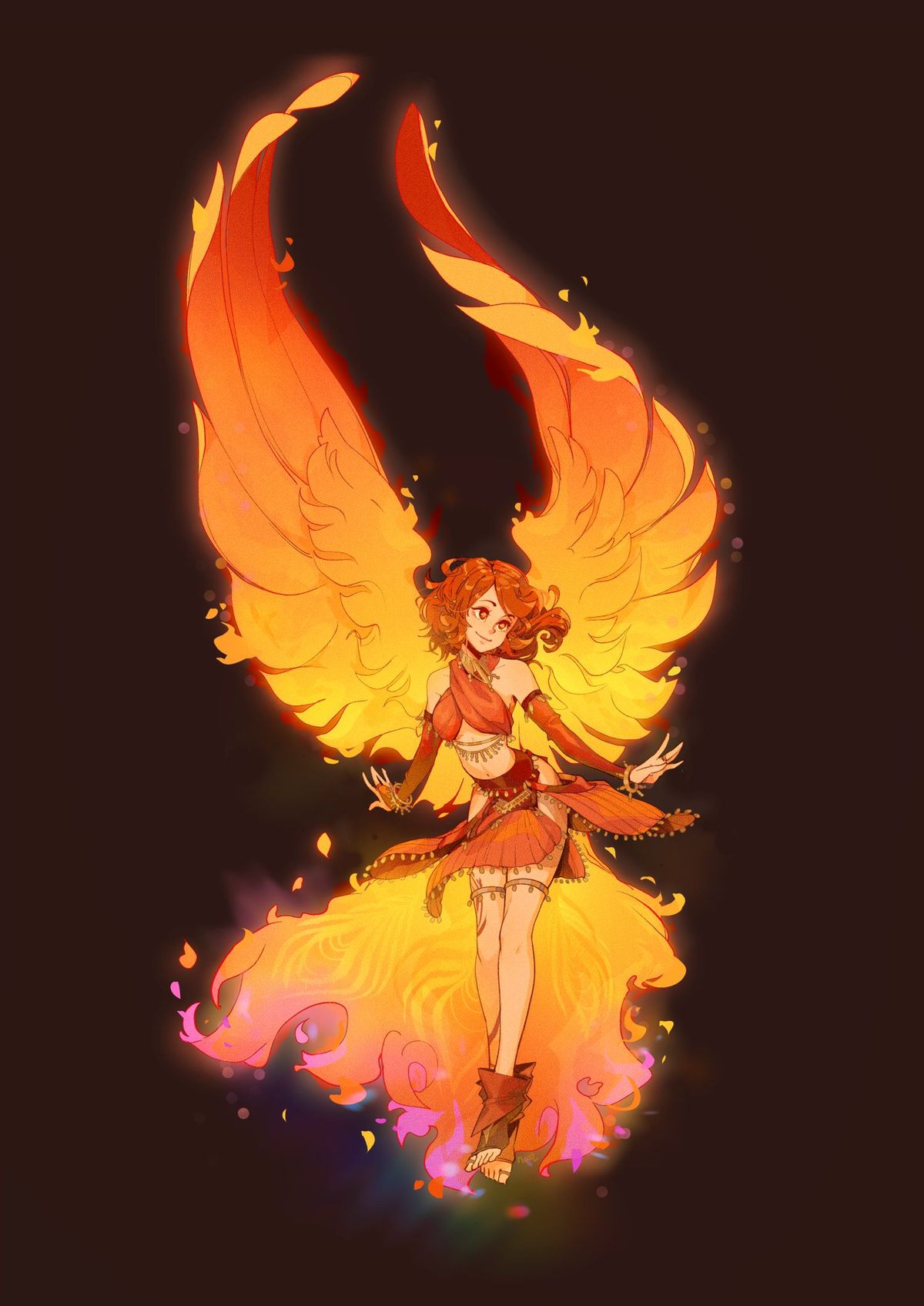
Orange and red-skinned, hardy past the point of stubbornness, and permanently at war with one another, the Salamanders hold the desert — and hold it badly. The Emberwaste offers almost nothing: a few springs, a few shaded canyons, a few workable glass-fields. Everything a Salamander has, another Salamander wants, and the resulting cycle of raids and reprisals has run without interruption for as long as anyone can document.
The Kingdom quietly encourages this. A united Salamander host would be the most dangerous army in the world, and a divided one is a reliable source of mercenaries.
Appearance
Deep orange through arterial red, with skin that runs hot to the touch and scars pale. Their wings are short, heavily veined, and usually singed at the edges — Salamander flight and Salamander magic are difficult to practice in the same moment, and most choose the magic.
The scarring is read, in the Emberwaste, the way a Ring noble reads a house sigil. Where and how a Salamander is burned says which fights they were in and which side of the vent they were standing on, and a smooth-skinned adult is assumed to have been somewhere very safe.
Attuned Magic
Fire. A nascent Salamander makes and moves small flames. A powerful one raises firestorms, shifts the heat across a whole canyon, and forges weapons out of living fire that cool into something no other smith can reproduce. It is the most immediately lethal of the attuned magics and the least subtle, a fact Salamanders are tired of hearing.
The subtle application exists and is not exported: heat removal. A Salamander can pull the warmth out of a body of air, which in a desert is worth more than any weapon, and which no war-chief has ever offered to teach an outsider.
Life
Holds of a few hundred, dug into canyon shade or glass, sited by water and never by preference. The day is nocturnal and crepuscular; the middle hours belong to the desert. Water is measured, and hospitality — which is absolute, and extended even to enemies under truce — is measured with it.
Names. Earned. A Salamander is called by a use-name until they have done something, and the something is expected within a few years. An adult still using their arrival-name is being told, politely and constantly, that they have not begun.
Arrival. New Salamanders are taken in by whichever hold finds them, fed, watered, and put in front of a fight as soon as they can hold something. This is not cruelty by local reckoning: it is the fastest route to a name, and a nameless person in the Emberwaste has no claim to water.
Water. Nine springs in the whole province, every one fortified. A guest is given water in the first minute or is not a guest, and the entire etiquette of the province descends from that single fact.
Society
War-bands under war-chiefs, with the Kiln — a fortress of fused glass — passing to whoever last took it. The Eternal City recognizes whoever is sitting in it, sends them a title, and otherwise does not involve itself. Barely three percent of Salamanders live in any settlement, because a hold that grows large enough to matter attracts an army.
Tribes
Three thirds of a hard country, and three quite different answers to it.
- The Boitatá (~120,000) range the Expanse as vaqueros on centipede-back, in the Desert Rose's service.
- The Ifrit (~150,000) cross the Red Sands in caravans, and answer to the Desert Rose at the Vermilion Court.
- The Cherufe (~130,000) work the Ashlands as glass-smiths and pyro-metallurgists, and socialise almost never.
Two of the three serve the Desert Rose. The third sells to her, which she has never mistaken for the same thing.
Currents
Vashruk's Host. The current holder, three years in, honoring terms he made with a garrison he beat — and trying to make the holding hereditary, which everyone can see.
The Ninespring Compact. A league of holds sworn never to contest the Kiln and to fall jointly on whoever takes it and then comes for them. The closest thing the province has to a constitution, and it works about two-thirds of the time.
The Glass Guilds. Cinderhold's craftsmen: sell to everyone, arm nobody, survive everything. The only neutral institution in the Emberwaste.
The Deep Song. Not Salamander. The sand-swimmers, who have decided that going deeper is no longer a strategy, and have begun surfacing at night, in numbers, saying they were here first — in a language a few Salamanders have finally learned.
Relations
The Emberwaste was not made for Salamanders. It was made for the sand-swimmers, an armored burrowing people shaped to drink from the sand itself, who were conquered long ago and are still there in far greater numbers than the Salamanders realize, having simply gone deeper. Faerie histories record the conquest as a heroic founding. The sand-swimmers record it in a song, in a language no Faerie has bothered to learn.
Playing One
- The most lethal attuned magic in the party, and everyone can see it coming. Fire is a statement. Learn when not to make it.
- Hospitality is binding. You gave them water; that is now a rule you are subject to, and it will be inconvenient at exactly the wrong moment.
- Your scars are your résumé to anyone from home and evidence of savagery to anyone at court.
- A starting complication: you have a name you earned in a raid you now understand differently, and one of the people who was on the other side of it has turned up with a claim.