The Eternal City
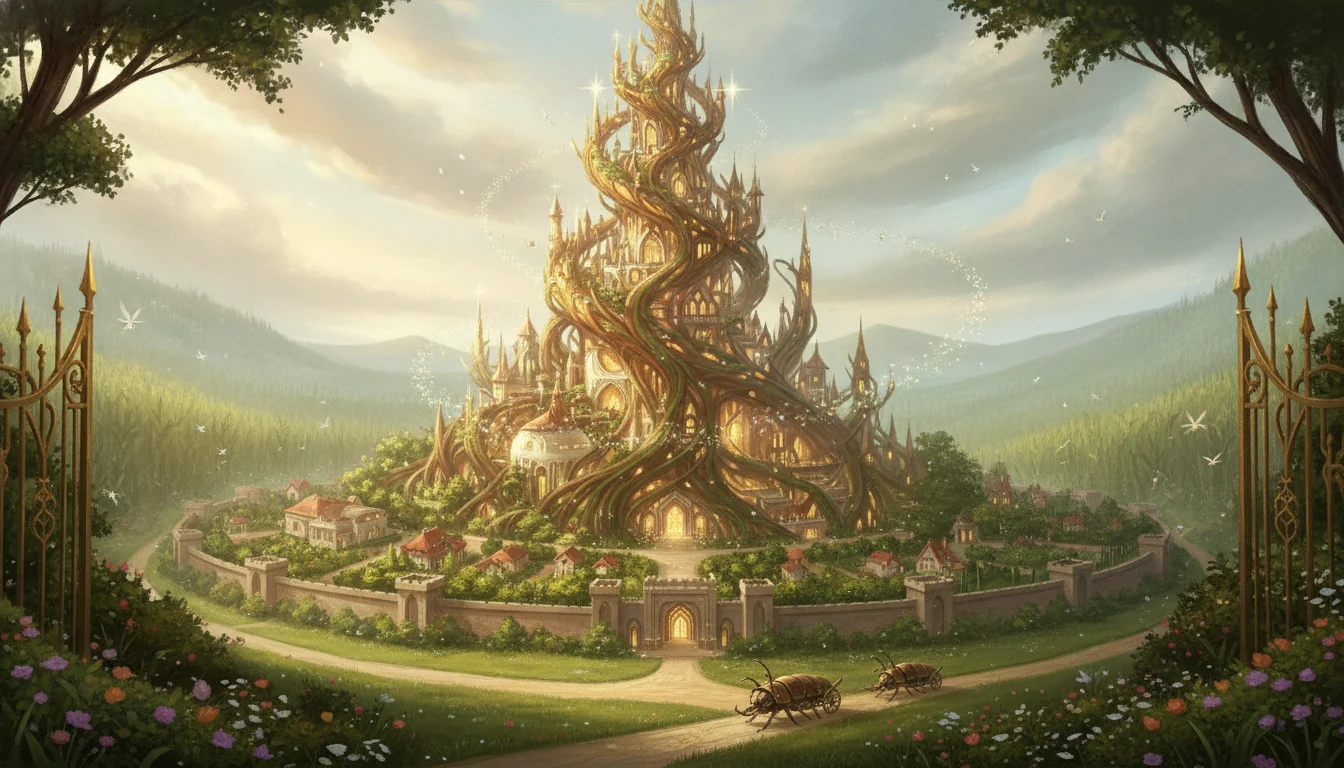
The capital, and the only place in the world a human would recognize as a city. It is grown as much as built — a vast spiraling structure of fused stem, resin, and dew-glass rising out of the meadow, catching the light so brilliantly that on clear days it can be seen from the borders of three provinces.
The Queen's court occupies the upper spires, which only the winged can reach. This is presented as ceremony rather than as the exclusion it plainly is.
Who Actually Lives Here
The city's rank order and its census disagree completely, and everyone has agreed not to make much of it.
The High Sidhe are the highest-ranking Faeries in Everdew short of the Queen and her immediate household. They are also less than one per cent of the city's population. The Ring is a very small place holding a very large amount of the world.
The actual majority is Sylph. The Flaunt are so overrepresented that Sylphs constitute a slim outright majority of the Eternal City's entire population — more than every other race and subrace put together. By any ordinary reckoning this is a Sylph city with an aristocratic quarter in it, and a good many Sylphs think exactly that.
They do not say it to a High Sidhe's face.
The Land
A city is a biome. This one is vertical, hot, bright, and entirely artificial, and it has produced weather of its own: the glass throws heat off the spires by mid-morning, and the resulting updraft over the central spiral is strong enough to carry a Sylph nine hundred feet without a wingbeat. Couriers ride the Thermal the way ships ride a current, and on still days the city's whole postal system slows to a crawl and everybody complains about it.
The glare is the other governing fact. Direct noon on the dew-glass is blinding, work stops in the upper tiers, and the city keeps a genuinely strange schedule: business at dawn and evening, sleep at noon, and a nocturnal second shift belonging to those whose eyes handle it — which is to say Chrysalid and Basekin crews, doing the day's real work in the dark and gone before the nobility wakes.
And it is a very long way down. Falls are the leading cause of death in the capital by a distance, and the second is what the Chancery euphemistically records as misadventure among unregistered persons.
Flora and Fauna
| Feature | What it is | Why it matters |
|---|---|---|
| Dew-glass | Resin fused with mineral water, grown in sheets | The city's material, its industry, and its glare |
| Spirevine | A cultivated climber that thickens the structure as it grows | The city is partly alive and is quietly still growing |
| Ring roses | Ruinously expensive imported blooms in ruinously imported soil | Status, entirely |
| Lampmoss | Bioluminescent understory hauled up from the Land of Night | Lights the Underfoot; dies in six weeks; replaced constantly |
| Scarab crews | Medium dung beetles, sanitation | The city would drown in a month without them |
| Silk-spider lofts | Diminutive weavers kept in the upper tiers | Court fashion; the weavers are paid in nothing |
| Butterfly stables | Show mounts, structurally useless | A noble house is judged on them |
| Booklice | Fine, tolerated, half-tamed | Eat the mold in the Chancery stacks and read what they eat |
The Ring
Around the city runs the Ring: a belt of High Sidhe estates, each held by a noble house, each competing to be the most beautiful and the most humanlike. The Ring's gardens are the most exquisite and most artificial landscapes in the world, grown at ruinous expense in soil hauled in from the provinces — the nobility have paved over the Heartland in order to build imitations of the Meadowlands.
The Underfoot
Beneath and between all of it are the service warrens where the capital's non-Faerie population actually lives. Ants, beetles, spiders, silkworms, and the occasional hobgoblin keep the Eternal City fed, clean, and lit, and are expected to be invisible while doing it. They appear in no census; the 90,000 figure is an estimate by a Leprechaun surveyor who was not asked to produce it.
More conspiracies are hatched in the Underfoot in a season than in the Outer Wilds in a decade.
Districts
The Spiral — the commercial tiers, wound around the city's core, where an address is quoted by height. Rent rises with elevation and so does the quality of the air.
Lampfoot — the lowest legal district, where the Spiral meets the ground and the Underfoot's shafts open. Markets, ostleries, and the only public houses in the capital where a Basekin can be served, in the back, quietly.
The Chancery of Forms — not a district but it functions as one: a whole quarter of clerks, registries, seals, and stacks, where the Kingdom's caste law is written, filed, and enforced. The ladder of personhood is painted on its wall.
The Verge — the outer estates of the Ring, where the newest houses build. Money, no history, and a great deal of ambition, which makes it the easiest place in the capital to be hired for something unwise.
Factions
The Houses of the Ring. Two dozen noble families, competing at ruinous expense in gardens, glass, and human imitation. They agree on nothing except the arrangement that keeps them there, and they have been known to fund quite radical people in order to embarrass one another.
The Chancery. The permanent government: registrars, heralds, and assessors who outlast every fashion at court. They are not cruel. They are worse than cruel — they are procedural, and the procedure is the caste system.
The Underfoot Combinations. Not one organization: a loose weave of warren guilds, water-carriers, scarab crews, and courier lines that can, between them, shut the capital's sanitation off. They have never done it. The threat is not spoken aloud because it does not need to be.
The Ninefold Chapel-in-Exile. A small Tenko mission in the upper Spiral, permitted because the nobility want blessings. Its priests give them, in wording that reads on close inspection as a warning, and the Chancery keeps a file on every sermon.
The Quiet Choir. Pooka singers working the Lampfoot houses, who have discovered that a tune passes a checkpoint no pamphlet survives. The censors have no vocabulary for prosecuting a melody and are visibly frustrated about it.
Sites of Interest
The Chancery Stacks. Four hundred years of registry in a resin vault the size of a province's granary, and the Kingdom's memory in its most literal form: land grants, caste assignments, caravan manifests, and the census that omits ninety thousand people living directly beneath it. The stacks are guarded, indexed, and read continuously by booklice who were hired to eat the mold and who have, without anybody intending it, become the best-informed scholars in the world. They will talk. Nobody has ever asked.
The Queen's Stair. The only route from the Spiral to the upper spires that does not require wings — a ceremonial ascent of nine hundred steps, opened once a year for a procession and sealed the rest of the time. Its existence is awkward, since the court's whole claim is that the spires cannot be reached unwinged, and the Stair is proof that somebody, at some point, thought otherwise and built accordingly.
The Sink. Where the Underfoot's runoff collects, four levels below Lampfoot: warm, lightless, and the closest thing the capital has to neutral ground. Goblin factors, Chrysalid couriers, Wardency informers, and at least one member of every noble house's household do business down here. The unwritten rule is that nothing said in the Sink is carried up. The rule is broken constantly and enforced brutally, which is why it survives.
The Gardens of House Ilvane. The most perfect landscape in the world: a recreation of a Heartland meadow, grown in imported soil, tended by three hundred uncounted hands, and closed to the public. Ilvane's own children have never been outside the Ring, which is to say they have never seen the thing the garden is a copy of. Their tutors regard this as an advantage.
Hooks
- A booklouse in the Chancery Stacks has read a land grant that predates the Kingdom's official history and would like, politely, to know what to do about it.
- A noble house hires the party to steal something from the Duskmarket in the Twilight Veil. The item is a portrait, and the face in it is the Queen's, and the painting is four hundred years too old.
- Sanitation stops for one day in the lower Spiral. The scarab crews say nothing, do nothing, and are entirely polite about it. The Chancery wants names. The party has been asked, by both sides, to find out whether this was a warning or a rehearsal.
- The Queen's Stair is found unsealed, one morning, in the wrong season, with fresh dust disturbed on the ninth step from the top.
- Someone in the Verge is paying handsomely for a living Chrysalid to attend a party — as a guest, in writing, with a seat. It is either the bravest thing anyone in the Ring has done in a century or a trap, and the invitation is real either way.
Relations
Everything answers here. Whether the Queen is a High Sidhe herself, or something above that tier reserved for her alone, is the one theological question the court permits to remain open.
Encounters
Roll d100. A city is a biome, and this one is vertical. Most of what a party meets here has a job and a grievance. CR is scaled to Faerie size — see Challenge by Size.
| d100 | Encounter | CR |
|---|---|---|
| 01–09 | 1d6 Chancery clerks with a writ, a seal, and a question about your registration | — |
| 10–16 | 2d6 scarab sanitation crew working a Spiral tier, off shift and talkative | 2 |
| 17–23 | 1 Flaunt retinue on butterfly mounts, blocking the lane entirely for the view | — |
| 24–30 | 1d4 Underfoot water-carriers hauling up from the Sink, uncounted and unhurried | — |
| 31–36 | 2d8 booklice in the Chancery stacks who have already read the file you want | 0 |
| 37–42 | 1d6 silk spiders out of a court loft: escaped, unpaid, and not going back | ½ |
| 43–48 | 1d4 houseflies over the Sink, which found the dead before the mourners did | ½ |
| 49–54 | 1d3 Shah Mira working the Gutters above the lane; the stairwell is trapped | — |
| 55–60 | 2d4 cockroaches in the Lampfoot drains, outlasting another siege | 1 |
| 61–66 | 1d3 jumping spiders running a courier line across the dew-glass | 1 |
| 67–71 | a fall from the upper Spiral — the leading cause of death here, and a crowd gathering | — |
| 72–77 | 1d2 house centipedes arriving from a ceiling nobody can see | 3 |
| 78–82 | 1 hornet in the Thermal over the central spiral, hunting the postal lane | 4 |
| 83–87 | 1d2 rats in the warrens: clever, organised, and negotiating in good faith so far | 12 |
| 88–91 | 1 weasel loose in the Underfoot, which the Chancery is recording as misadventure | 15 |
| 92–94 | 1 pigeon on a Ring ledge, homing, and carrying somebody's correspondence | 9 |
| 95–97 | 1 magpie in the Verge with something from a noble house in its beak | 17 |
| 98–99 | 1 hawk stooping into the Spiral after a courier | 20 |
| 00 | 1 cat in the Ring gardens — beloved, unhunted, and it sees through glamour | 26 |