The Chrysalids
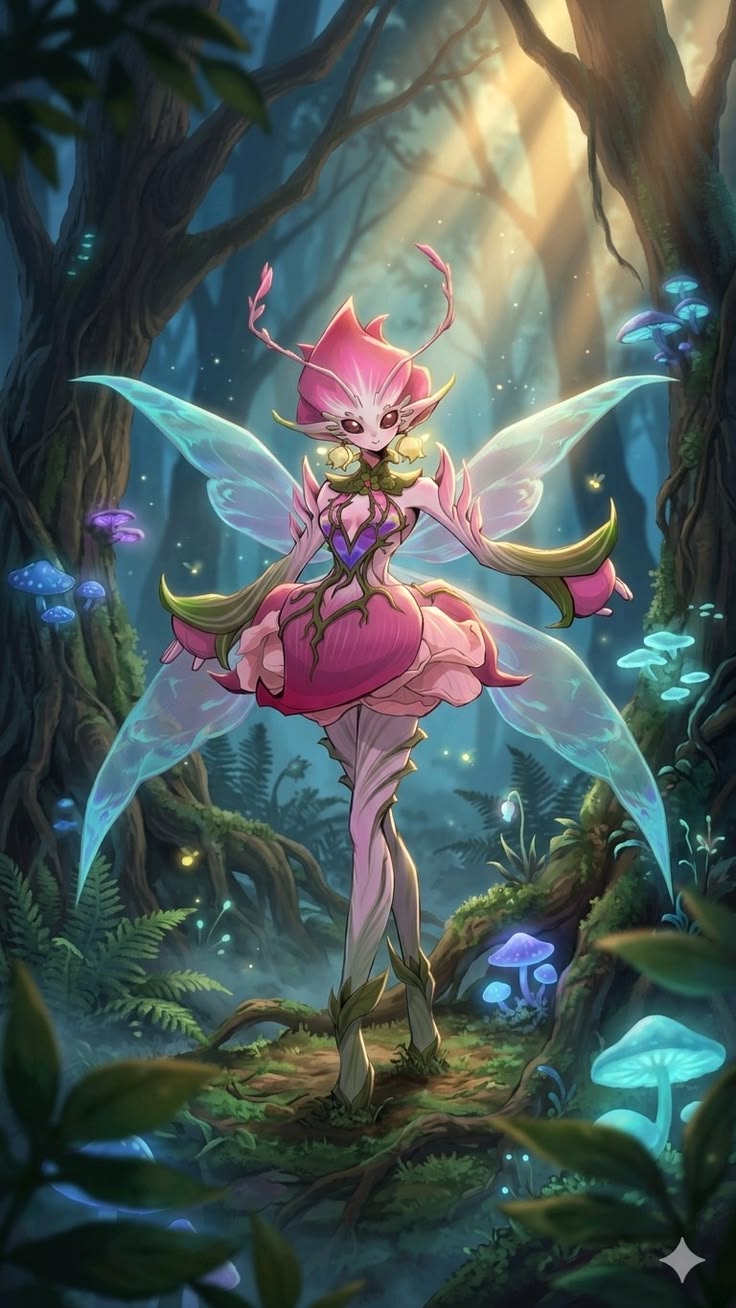
A Chrysalid stands like a Faerie, moves like a Faerie, and has a face that a Faerie cannot look at for long. The silhouette is right — two arms, two legs, a person's proportions, a person's hands — and everything drawn onto it is from somewhere else: eyes the size of plums and black all the way through, chitin plating along the forearms and collar, feathered moth-antennae rising from the brow, ears far past any reasonable use, folded wing cases where a Faerie's wings would be summoned and where nothing is ever summoned.
They are the only Basekin caste that frightens the nobility, and the fear is precisely because they are so nearly the thing the nobility claims to be.
The Uncanny Valley
The Court's aesthetic doctrine runs on distance. A beetle is comfortably far from the human form; a Feral-Kin is far enough to be pitied at a safe remove. A Chrysalid is a hand's width away, and the remaining hand's width is unbearable.
High Fey courtiers describe the sensation with unusual candor and no insight whatsoever: that a Chrysalid in a room makes the room wrong, that the eyes track without blinking, that one cannot tell what the face is doing. What they are describing is a person who resembles them, which their entire hierarchy insists should be a virtue, producing revulsion instead. Nobody at court has followed that thought to its end in public.
Doctrine
Where the Feral-Kin get pity, the Chrysalids get dread.
Court theology holds them to be caught mid-metamorphosis — not stalled, as the Feral-Kin are said to be, but in motion, unstable, and going somewhere nobody can name. The word chrysalid is the argument in a single term: a thing in a shell, mid-change, whose result is unknown. From there it is a short step to what the sermons actually imply, which is that a Chrysalid represents a failed, mutated, or heretical path of advancement — a soul that took the ladder sideways.
This is the one caste doctrine treats as contagious. A courtier who would happily accept a mouse-drawn carriage will not have a Chrysalid in the house, on the grounds — unstated, universally understood — that whatever went wrong there might be catching.
The doctrine is also, on the Court's own terms, incoherent. If form is a station one passes through, then everyone in the Kingdom is mid-change, and a visible in-between is not a heresy but a diagram. The Tenko of the Elderlands have made roughly this point about the whole doctrine of advancement. They have not made it about the Chrysalids specifically, and it has been noticed that they have not.
Where They Live
Everywhere, thinly, and in the Land of Night in numbers nobody official has counted. Night eyes and night ears are worth more there than a face anyone likes, and Lumenhal's observatories have for centuries employed Chrysalid observers who can read a plate in the dark and hold a figure steady through an eight-hour watch.
The astronomers do not put their names on the records. Four centuries of celestial observation sit in Lumenhal contradicting the doctrine of metamorphic advancement, unpublished, and a meaningful share of it was taken down by people the doctrine classifies as its own worst outcome. Astronomer-Primary Vesperine is aware of this. Vesperine is aware of a great many things.
Elsewhere they are found where the light is poor and the work is skilled: the Duskmarket in the Twilight Veil, the deep glass-shops, the night-post, and the long watches nobody else wants.
Relations
Cold with the Kingdom, and colder with the High Sidhe in particular, whose discomfort is the most acute and the least examined. Correct with the Wisps and the Spriggans, whose provinces run on night work and who have learned to value an employee they cannot lose in the dark.
Guarded with the Goblins, oddly. The Goblin King's banner is reclaimed ugliness, and a Chrysalid is not called ugly — a Chrysalid is called wrong, which is a different accusation and does not have a banner yet.
Closest, quietly, with the Low-Brood. The moth-featured and the moths have arrangements that predate the Kingdom's interest in either, and the couriers who carry mail no one asked permission to send are as often Chrysalid as corvid.
"The Court fears them because they look almost right. Nobody has asked whether the Court is afraid of being looked at almost rightly."