Wisp
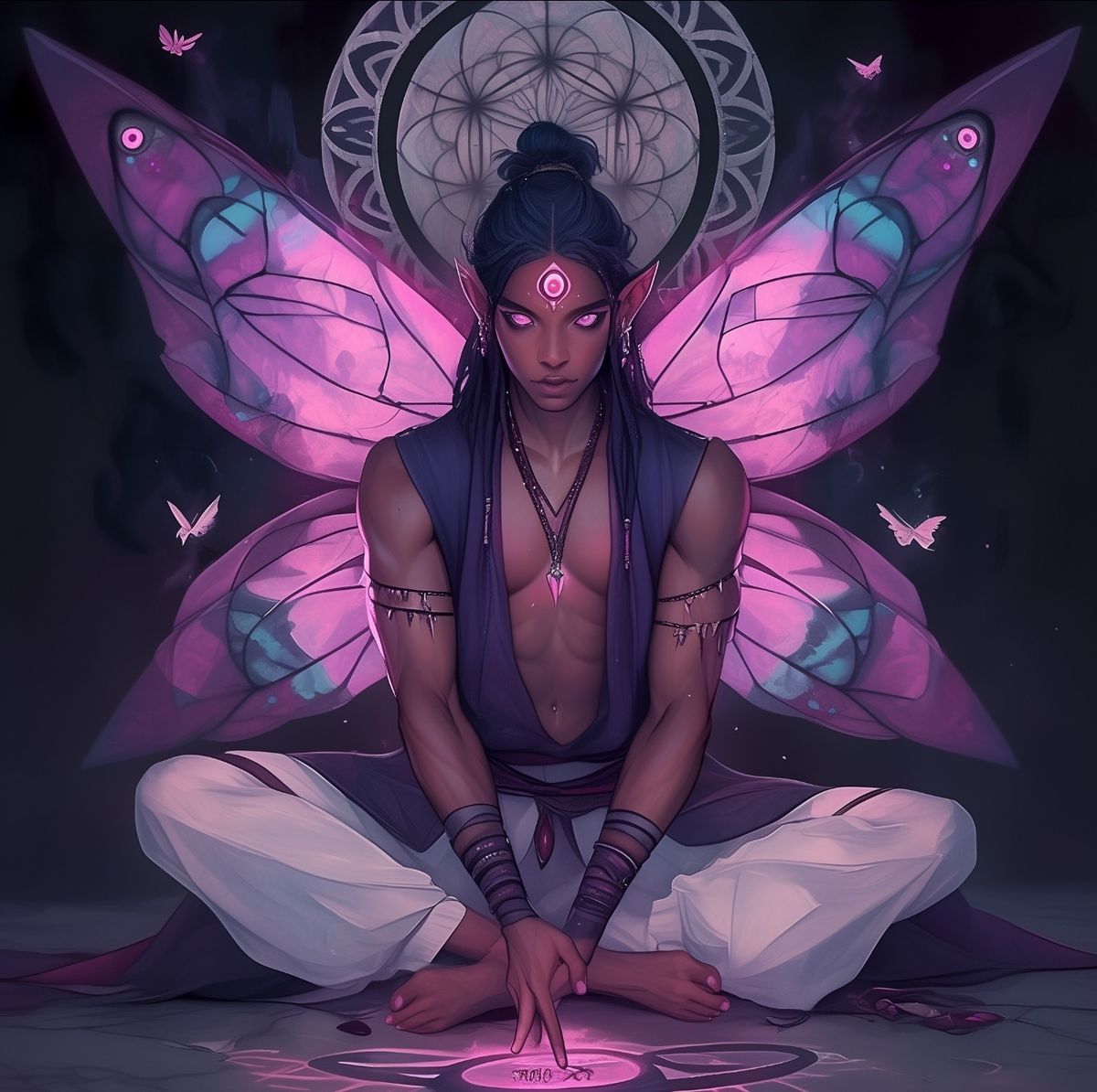
The Wisps are radiant fey out of the land where the sun never clears the horizon. They are bioluminescent — every one of them carries a unique pattern of light across wings and skin, as distinctive as a face and considerably harder to disguise — and their magic is celestial, drawn from moon, aurora, and star rather than from any element of the ground.
As Faeries go they are patient and slow to judgment, preferring to sit with a question for a decade before answering it. This is generally taken at court as proof that they are gentle and unthreatening.
Appearance
Pale to translucent, lit from within, with markings that shift slowly over a lifetime and never repeat between individuals. A Wisp cannot easily hide. The glamour required to mask one's own light is the hardest thing most Wisps ever learn, and many never manage it.
The shifting is also a record. An experienced Wisp can read another's approximate age, and something of their health, off the drift of the pattern — and no Wisp has ever explained this to an outsider, because a people who cannot hide keep what privacy they can.
Attuned Magic
Celestial. A nascent Wisp makes light, reads it, and knows their exact position beneath open sky. A powerful one bends light around objects, calls down a beam sufficient to burn, reads the immediate past of a place from the light still leaving it, and — the discipline Lumenhal is actually famous for — predicts the sky with unnerving precision.
Reading the light still leaving a place is the working other realms would most like to buy, and the one the Observatory most carefully does not teach: it is, functionally, seeing what happened here a moment ago, and it works better in the dark.
Life
Low halls beside still water, lit by lampmoss, run on a schedule of bells because there is no sun to run on. Work is observation, lampmoss farming, and the barge trade that carries light out of the province. The province is cold, quiet, and beautiful past description, and everyone in it is slightly sleep-deprived.
Names. For the light. A Wisp is named for their pattern at arrival — Vesperine, Ninefold-Blue, Slowmarch — and since the pattern drifts, an old Wisp's name is a description of somebody they no longer look like, which they find funny and outsiders find sad.
Arrival. A new Wisp is taken out onto the flats on their first clear night and shown the sky, and asked nothing at all. The custom is that they speak first, whenever they are ready, and nobody prompts them. It is the gentlest arrival custom in the Kingdom and it has produced, over four centuries, an enormous archive of first sentences, which the Observatory keeps.
Nightsickness. Visitors lose the day, then sleep, then judgment. The bells are a kindness and obeying them is not optional.
Society
Lumenhal is an observatory-city of stacked lenses and still pools, and Wisp society is organized around the reading of the sky, which they hold to be the closest thing the world has to scripture.
Rank is by observation-hours, which makes it one of the few institutions in the Kingdom where a commoner can outrank a noble by refusing to sleep.
Its astronomers, under Astronomer-Primary Vesperine, have been quietly compiling something uncomfortable: the celestial record does not support the doctrine of metamorphic advancement. They have not published. They have been not-publishing for roughly four hundred years, and whether to keep not-publishing is the central political question of Wisp society.
Tribes
The Void took the Wisps' country and left them three irreconcilable answers about what to do next.
- The Memoria (~110,000) walk World's End recording what is being erased, and hold that the record is the soul.
- The Lumina (~85,000) hold the Ivory Towers, keep rescued life in radiant stasis, and call recording a surrender.
- The Vastra (~60,000) are bodiless merchants working out of Antah-Bazaar, and claim to carry the oldest Wisp culture of all.
The argument between the three is four centuries old, entirely sincere, and the reason the Land of Night has no single voice at court.
Currents
The Publication Party. Astronomers who hold that the truth is not theirs to keep. A minority for four centuries, and not a minority now, and nobody has said so in session.
The Sealed Hand. Those who argue it must never be published — not from loyalty, but because they have thought carefully about what happens to 250,000 Wisps in a province the Kingdom could close in a season.
The Barge Guild. Palewater's light-shippers, politically uninterested and decisive: if the record ever leaves, it leaves on their barges.
The Bank Speakers. Glowworm observers keeping a parallel record in their own notation. It agrees with Lumenhal's. Two astronomers have understood what that means.
Relations
Distant from everyone, which suits them. The Kitsune of the Elderlands are the only race they correspond with regularly, and the correspondence is careful, because both parties have independently concluded that the Kingdom's theology is wrong and neither is yet willing to say so first.
Playing One
- You are a light source that cannot be turned off. Superb for reading a dark room and catastrophic for hiding in one.
- You can read what just happened here. The party's best investigative tool, and it works best where they least want to go.
- You are trusted because you are thought harmless, which is a resource with a limited lifespan.
- A starting complication: you carry a copy of something from the archive, you were not authorized to have it, and you are the least concealable courier in the Kingdom.