The Land of Night
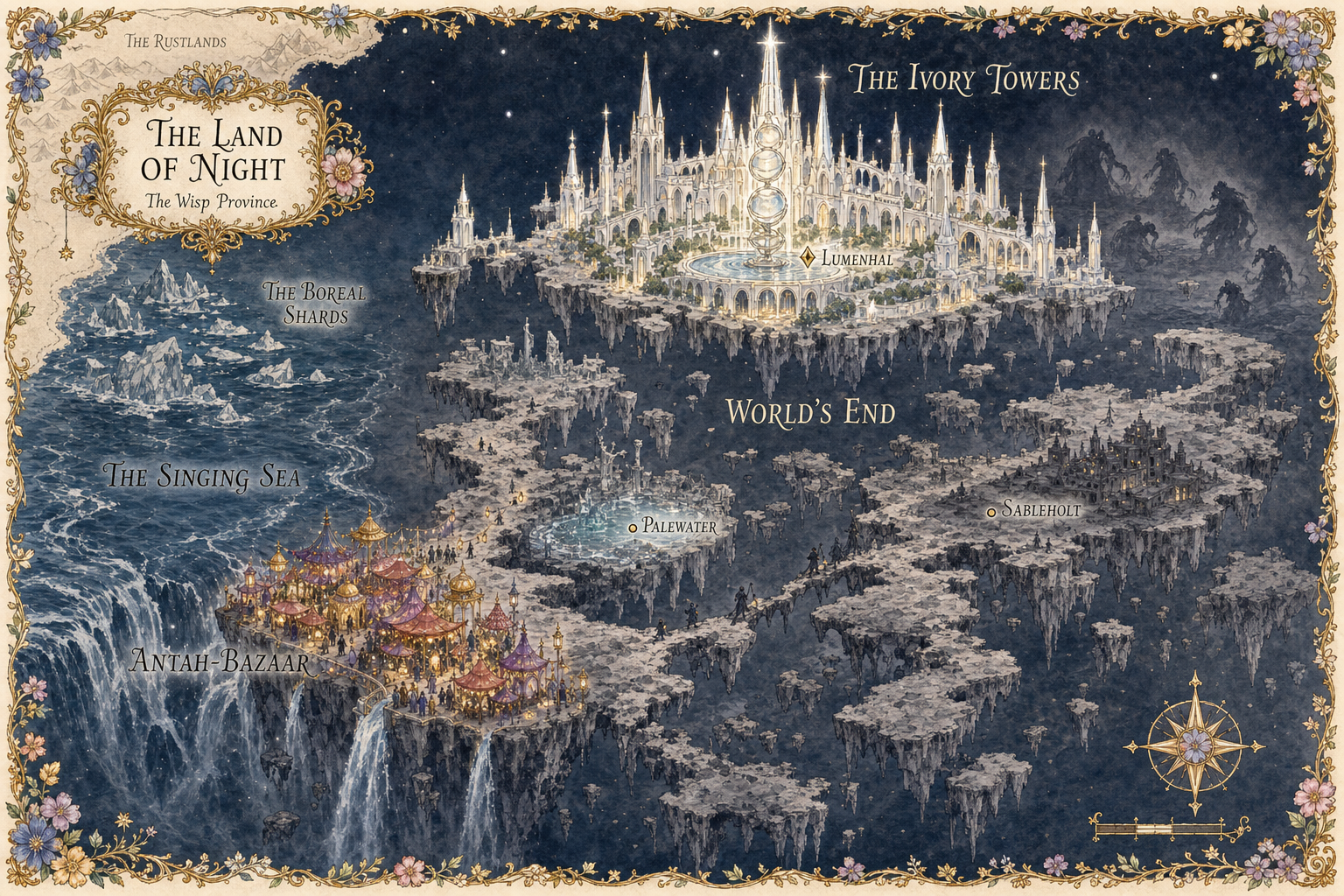
A region under permanent star-sky, where the sun never quite clears the horizon and the world is lit by moon, aurora, and the bioluminescence of everything living in it. It is beautiful past description and utterly disorienting to visitors, who cannot tell time and slowly go strange.
The Land
Low, open, and cold, with still water everywhere — the pools are instruments as much as landscape, and disturbing one during an observation is a serious offense.
The province is a bowl of black ground, silver water, and cold light. Every living thing here glows, because in a world with no sun the only way to be found is to shine, and the entire ecology has organized itself around signal: warnings, lures, courtship, and lies. A visitor's first night in the Land of Night is an experience of overwhelming beauty. Their fourth is when the trouble starts.
- Nightsickness. Faeries from elsewhere lose the day. Sleep unravels over about a week, then judgment, then memory. Locals recognize the symptoms instantly and are kind about it. The province's inns keep timed bells for this exact reason and visitors are strongly advised to obey them.
- The cold. Nothing warms the ground here. It is not Rimeward cold, but it is unrelenting, and the province's water is all one degree from ice.
- The aurora. When it runs strong, magic goes strange: attuned workings misfire, glamour slips, and compasses of every kind — magnetic, magical, or memorized — become suggestions. Aurora nights are for staying indoors, and the Wisps mark them on public calendars.
- The lures. Half the things that glow out on the flats are advertising, and the other half are fishing. There is no way to tell by looking, and the standard local advice — never walk toward a light you cannot name — is the province's single most repeated sentence.
- The stillwater. The observation pools are perfect mirrors. They are also, at Faerie scale, lethal: unbroken surface tension over cold, deep water, and no way to get out without help.
Subregions
World's End. Islands of greying stone adrift above the void, roamed by the Memoria, who record what the Void is erasing, and contested by the Hunger.
The Ivory Towers. Radiant spires floating unanchored above the fading islands, where the Lumina hold rescued life in stasis and argue that recording is not enough.
Antah-Bazaar. A tent-city of silk and brass at the very lip of the cataract, run by the bodiless Vastra, and the liveliest market in Everdew.
Flora and Fauna
| Feature | What it is | Why it matters |
|---|---|---|
| Lampmoss | The ground cover; glows blue-green, farmed everywhere | The province's light, food, and only export in volume |
| Starwort | Flowers that track the sky and open by constellation | The Wisps use them as clocks and calendars, seriously |
| Ghost-reed | Pale reeds around the pools that fluoresce under aurora | Beautiful. Also the only warning that the aurora is strong |
| Lurebloom | Glows exactly like a lampmoss lantern; carnivorous | Kills more travelers here than anything with teeth |
| Fireflies, greater | Tiny; wild-swarm rather than farmed | The province's weather, effectively. A swarm night is an event |
| Glowworms | Diminutive; carpet the pool banks, and speak | Lumenhal's night crews; unpaid, uncounted, indispensable |
| Barn owl | Gargantuan; silent, hears a heartbeat under snow | The province's apex terror. There is no cover on the flats |
| Bats | Large; hunt by sound in the dark that never ends | Constant. The Wisps have simply built around them |
| Moths | Medium to Large; drawn to everything | Both the local transport and the reason lights are shuttered |
Lumenhal
An observatory-city of stacked lenses and still pools, built for reading the sky. The Wisps regard the stars as the closest thing the world has to scripture, and Lumenhal's astronomers have been quietly compiling something uncomfortable: the celestial record does not support the doctrine of metamorphic advancement.
They have not published. They have been not-publishing for about four hundred years, and the argument over whether to keep not-publishing is the central political question of Wisp society.
Other Settlements
Palewater (7,000) — a lampmoss town on the great shallow pool, and the province's actual economy: moss beds, drying racks, and the barges that carry light to the Twilight Veil and the capital.
The Ember Line (4,000) — a string of hostels along the western road where visitors acclimatize, ring the bells, and are watched for nightsickness before being allowed further in. Half sanatorium, half checkpoint.
Sableholt (2,000) — a hold on the dark flats where nothing glows at all, by ordinance: the one place in the province with true blackout, kept for observations that require it. Its residents are odd even by Wisp standards.
The Glowworm Banks (uncounted) — settlements of speaking glowworms along every pool, who do the night work Lumenhal runs on and hold no seat in it. They are, by a wide margin, the best observers in the province.
Factions
The Observatory. Vesperine and the astronomer-ranks: the province's government, its faith, and its archive. Rank is by observation-hours, which means the Observatory is one of the few institutions in the Kingdom where a commoner can outrank a noble by simply not sleeping.
The Publication Party. Astronomers who want the four centuries of record released, on the grounds that the truth is not theirs to keep. They have been a minority for four hundred years. They are not a minority anymore, and everyone in Lumenhal knows it, and nobody has said it in session.
The Sealed Hand. Those who argue the record must never be published — not out of loyalty to the crown, but because they have thought carefully about what happens to 250,000 Wisps in a province the Kingdom could close in a season.
The Palewater Barge Guild. Light-shippers, and the province's only real contact with the outside. Politically uninterested and commercially decisive: if the Observatory ever does publish, the Guild's barges are how it leaves.
The Bank Speakers. Glowworm observers who have begun keeping their own record — parallel, independent, and in their own notation. It agrees with Lumenhal's. That it exists at all means the Observatory's secret is not the Observatory's to keep, and only two astronomers have realized this.
Sites of Interest
The Deep Lens. Lumenhal's great instrument: nine ground lenses stacked over a still pool sixty feet across, aligned once a generation, capable of resolving things in the sky that no other people in the world know are there. It is used four nights a year. The other 361 it is guarded, and the guard roster is the most heavily audited document in the province.
The Four Hundred Years. The archive: a vault of nightly observation running back four centuries without a single gap, kept in a hand-copied notation only astronomers read. It is the most complete scientific record in the world and it quietly contradicts the theological basis of the Kingdom's entire social order. It is also, physically, a room full of paper in a cold province, and the Sealed Hand has pointed this out more than once in a tone that some members found unsettling.
The Mirror Flats. A stretch of shallow pools that go dead calm in still weather and reflect the sky so perfectly that the horizon disappears. Faeries have walked into them and drowned believing they were flying. It is also the province's most sacred ground, and the Wisps' dead are laid out there, on the water, on nights when the aurora runs.
Sableholt's Dark Room. The blackout hold's central chamber, where no light of any kind is permitted, used for observations of things too faint to see near a glow. Three separate observers over two centuries have reported that during a long dark session, they could see something in the room. All three reports are in the archive. All three are in the same handwriting, which is the part nobody discusses, because the sessions were ninety years apart.
Hooks
- The Publication Party wants a copy of the archive carried out of the province and lodged somewhere the Kingdom cannot reach — the NoneElderlands, the Duskmarket, or the Wilds. The Sealed Hand knows the attempt is coming.
- A party member develops nightsickness on schedule and starts remembering things that have not happened yet, which the local hostel-keepers treat as a known and worrying stage.
- A glowworm bank speaker asks for a Faerie willing to read their record into evidence at Lumenhal. It is a request for personhood dressed as a request for a favor, and everyone involved understands that.
- The aurora has been running for nineteen nights. Magic is unreliable, the compasses are lying, and something has been moving on the Mirror Flats that the owls are avoiding.
- Vesperine sends for the party personally. The instruction is to walk to a specific point on the dark flats on a specific night, look up, and come back and describe what they saw — without being told what they are looking for, and without an astronomer present.
Relations
Distant from everyone by preference. Lumenhal corresponds carefully with the NoneElderlands, both parties having reached the same heretical conclusion from opposite directions, and neither yet willing to say it first.