Everdew
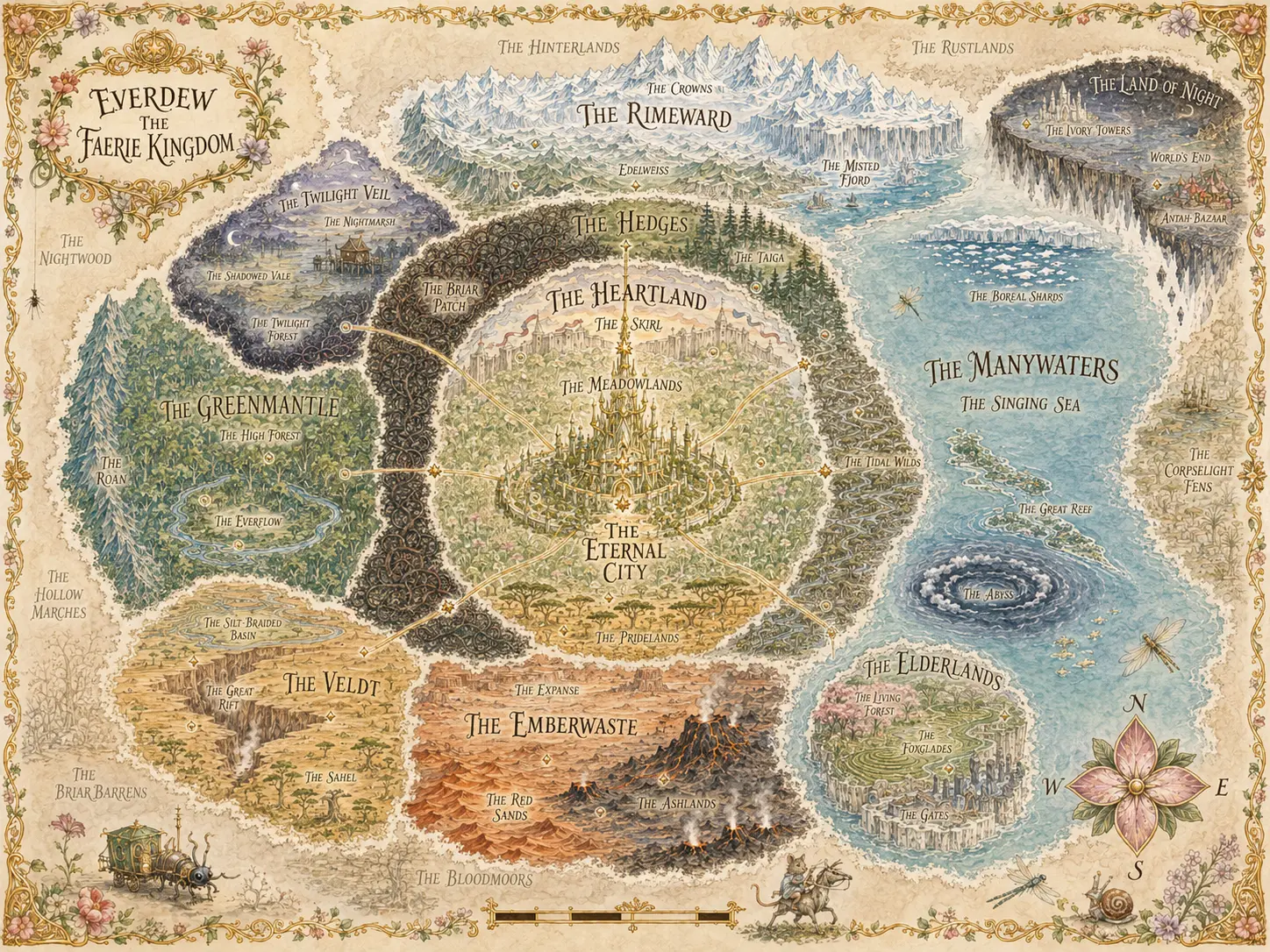
A campaign setting of the very small: faeries, bugs, and the world beneath our feet.
The Kingdom of the Faeries is ruled by an immortal Queen, beautiful, powerful, and perfect in every way. The PCs are more common faeries: sylphs, spriggans, undine, etc. Like all faeries, they are playful, mischievous, and often driven by curiosity rather than reason. The Kingdom exists within a greater magical world filled with insects, animals, and fantastic creatures. The realm resembles our world, but richer, more verdant, and more diverse in its biomes and environments. Our world does exist, a parallel and scary place full of enormous creatures, including the most terrifying of all: humans. In that world, we can only exist in hiding, unseen, in disguise (as natural creatures or inanimate objects), and in constant fear of natives that can sniff us out, such as the dreaded colossi known as "cats".
The Queen's brother once ruled by her side, but he grew jealous of her power and sought to overthrow her. This led to a great conflict within the Kingdom, resulting in his banishment and the consolidation of the Queen's absolute rule. In his exile, he has consolidated power amongst the "bad" fey, the ones who are exactly as tricksy and mischievous as "good" fey, but ugly: goblins, redcaps, and other malevolent creatures of the dark woods. He now reigns as the Goblin King, promising to return with his army and reclaim the throne from his sister, uniting all of faerykind--a disgusting prospect (remember how I said they're ugly?).
Index
- People — the Faerie races, the Goblin races, the Non-Faerie castes, and the notable individuals of every realm
- Places — the twelve provinces of the Faerie Kingdom and the nine territories of the Outer Wilds
- Things — flight, glamour, attuned magic, and metamorphosis; the monsters that hunt Faeries and the beasts they hunt with
Themes
On a thematic level, the setting first glorifies the fuedalistic autocracy of the Faerie Kingdom, while gradually exposing the exploitation and oppression inherent in its social structure. The PCs should gravitate toward a populist perspective, challenging the established order and advocating for the rights and freedoms of the common faeries, and in particular questioning the dogma that the more humanlike the faery, the better of a faery they were considered to be, with the Queen being indistinguishable from one. It seems strange to idolize such creatures who have made a ruin of their world, defiled the beautiful nature that mirrors their own.
There is also a theme that Faery reflects the human world, and as the humans have corrupted and exploited their environment, so too have the faeries mirrored these actions in their own realm in their emulation of these "godlike" beings.
Beneath the notice of the Faerie Queen, the many intelligent creatures who aren't her subjects have their own challenges and struggles, which are not helped by the dehumanization (or de-faery-ization) they experience at the hands of the ruling faeries. Bugs and tiny creatures of every sort in this world are all intelligent beings, intellectual equals of faeries, but considered "not people" solely for their appearance. Their societies get by with what scraps the faeries leave them, but they are treated the way humans treat animals, or the humans they call "savages": acknowledged as intelligent, but somehow unworthy to own land or property or manage their own affairs. This dynamic creates a rich tapestry of hidden civilizations, secret alliances, and underground networks where these marginalized beings navigate their existence, often outwitting the faeries who underestimate them.
While the Queen is effectively worshipped by her sycophants, she is not truly divine. There are, in fact, divine beings and energies in this world, which intended the beauty and splendor of the realm to be shared by all. All fey creatures are immortal and inherently magical, and there are infinite resources for all. There is no reason for a social hierarchy, nor exploitation of any kind, and every creature is beautiful just the way it is.
Perhaps the the origin of this social evil stems from what may have been a mistake in the world's creation: creatures can metamorphose into other forms. No faerie was ever born, and yet they did "begin" at one point, metamorphosing from a previous form, losing the memories of the old. This leads to a concept analogous to mortality, which, given the intelligence of the faeries, evolved into a concept more similar to Karma, where faeries assume that their deeds will determine when they "advance" into a "higher" form. The stratified society is accepted, because the faeries believe that, through right thinking and action, especially devout service to the Queen and the order she represents, they too can one day evolve into "higher" forms, enjoying the privileges denied to them by the stratified society of the present. And so do the oppressed many willingly support the system of oppression.
#themes
Races
Broadly, the races of this setting can be divided into three categories. Details are on the People page.
- Faeries: The dominant race in this setting, known for their intelligence, magical abilities, and hierarchical society centered around the Faerie Queen. They all look distinctly humanoid, although the lesser forms have pronounced sylvan characteristics. Still, they are all considered "people" within the Kingdom, if not all "noble".
- Goblins: A broad designator of faery-like races, still usually humanoid, but ostracized for their ugliness. Through common prejudice and social stigma, goblins are united into a hetergenous group, and have been further solidified under the Goblin King, proudly reclaiming the epithet "goblin" as a badge of honor.
- Non-Faeries: All other intelligent creatures who are not faeries or goblins. This category includes a wide variety of beings, from insects and small animals with human-like intelligence to other fantastical creatures. They are often marginalized and live in hidden or secretive communities, navigating a world dominated by faeries and goblins. The court sorts them into four castes: the Elderborn, too old and too powerful to be ruled, and — below the Kingdom's line of personhood — the three castes of the Basekin, the Low-Brood, the Feral-Kin, and the Chrysalids, ranked by how nearly their bodies resemble a human one.
Locations
Full detail is on the Places page. In brief:
- The Faerie Kingdom is comprised of the homelands of each of the Faerie races, centered on the windy meadows of the Heartland, home to the Slyphs and the capital city.
- The lands outside the kingdom aren't quite the same--rather than each goblin race having a homeland, the Outer Wilds are a mix of total wilderness and ruins being reclaimed by the wild, echoes of the Kingdom's distant past, suggesting a decline. In some cases, these lands seem to have been the homeland of a goblin race, albeit in a previous form that may once have been more "acceptable" to Faeries. In others, even the Faeries aren't quite sure the origins of the land.
- Each region has a center of power. In the case of the Faerie lands, this is usually the home city or settlement of its dominant race, although there is a bit of room for variation. Gnomes, for instance, don't really go down for centralized government, preferring to keep within their large familial clans, so their central location may be some magically and geologically significant underground location where clans come to meet each other and even entreat with the other denizens of the underground. Slyphs also have no race-specific center, as theirs coincides with the capital city, giving them a certain "first among equals" feel, but also a subtle sense of loss of identity compared to the other races.
- The outer wilds sometimes have centers of power--usually military in nature, with the strongest local power keeping a sort of order--but some environments are too harsh for any remotely civilized settlements to last in one place. The Goblin King brings order, but he has no throne--he is always on the Great Hunt, nomadically roaming the Outer Wilds with his court. This is, in part, to keep his rule safe from any organized military action from the Queen.
- Overall, this world is Earthlike, with soil, rain, sunlight, plants, animals (all intelligent, sentient, and speaking), and a variety of climates and terrains similar to those found on Earth. Compared to Earth, it is lush and abundant, and exaggerated, with climate types and biomes that wouldn't make sense on Earth. While there are environments that are harsh and resource poor for some or even the majority of inhabitants, there is always some race or creature that thrives there. The intent of the world's creators was to give life infinite resources, but also to promote great diversity, so not all regions are equally hospitable to every race or creature. The deserts home to the Salamanders, for instance, were not meant for them--they were conquered long ago, by creatures ill-suited to the terrain, and despite adapting to it, the Salamanders are still strapped for resources to the point of constantly clashing with each other over them.