The Great Hunt
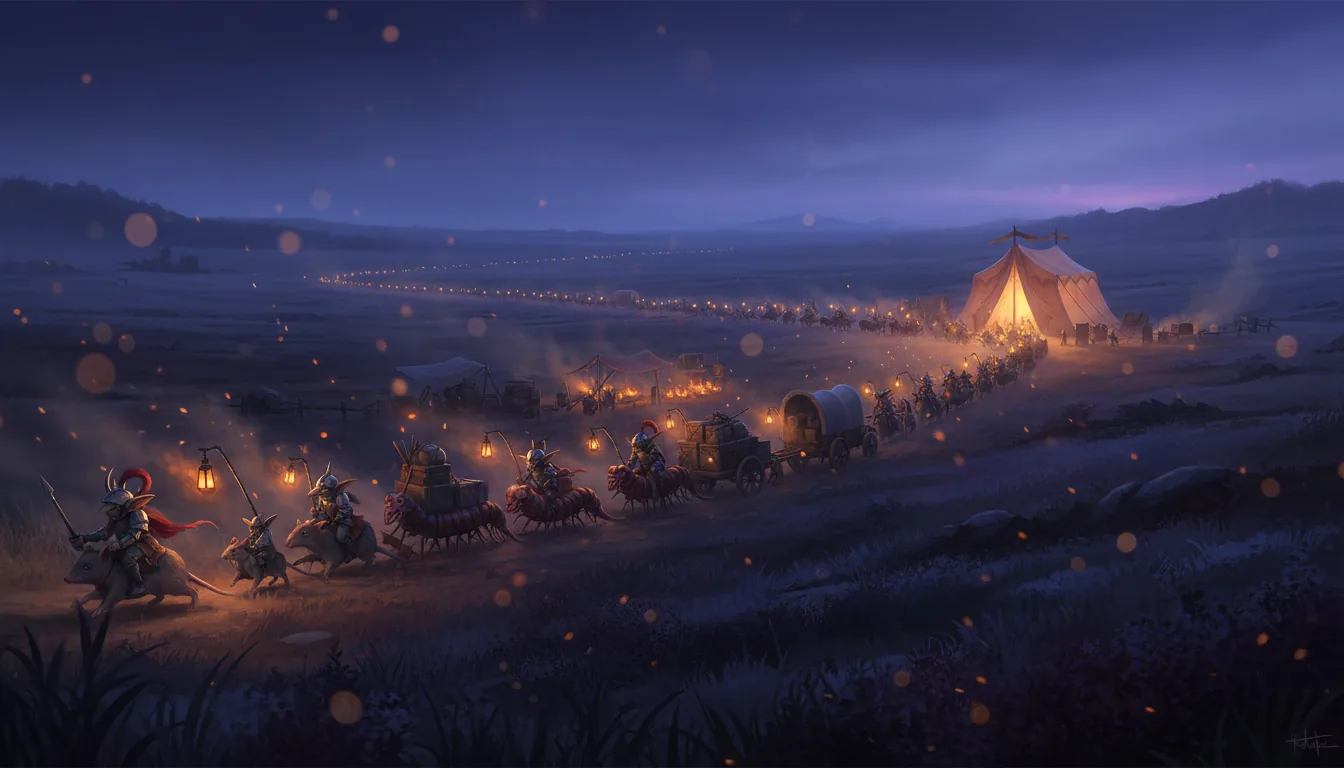
The Goblin King brings order to the Wilds, and he does it without a throne. The Great Hunt is his court, mounted and perpetually moving: it arrives, holds assizes, settles disputes, collects what it needs, and is gone before any army could be brought to bear on it.
Being on the Hunt's route is the closest thing the Outer Wilds have to citizenship.
Why It Moves
Partly because the Wilds have no single place worth ruling from, and partly — mostly — because a fixed capital could be besieged. The Queen's forces have never been able to bring the Goblin King to battle on ground of their choosing, and every attempt has ended with an expensive column standing in an empty campsite.
The Column
Four thousand in the court proper, and about that again in the trailing camp that nobody counts: farriers, brewers, apothecaries, families, debtors, hopefuls, and a permanent market that assembles in an hour and dissolves in twenty minutes.
The Hunt is a working landscape of its own. It moves at the pace of the slowest beast in the train — mouse cavalry can outrun anything, but the ovens cannot — and its day has a shape everyone in the Wilds knows: outriders at first light, column moving by mid-morning, camp struck and the market open by dusk, assizes after dark.
- The muster horn. Camp can be struck and the column on the move in the time it takes to explain why. This is the Hunt's entire defensive doctrine and it has never failed.
- No fires above a certain size. A settled camp is a target and a large fire is a settled camp. The Hunt eats cold more often than it likes.
- The trailing camp. Whatever the court does, twice as many people do it slightly behind, without protection, and that is where the Hunt's real politics happen.
- Provisioning. The column consumes a district's surplus in a week, which is why the route matters so much and why an unannounced arrival is both an honor and a bill.
Beasts of the Column
| Feature | What it is | Why it matters |
|---|---|---|
| Mouse cavalry | Large mounts; the Hunt's speed and reach | The reason no Kingdom column has ever caught it |
| Hare heavies | Colossal; ruinous to keep, decisive when used | Gorrach fields nine. Nine is enough |
| Millipede freight | Large; a living wagon train, loaded segment by segment | The ovens, the forge, the assize tent, and the King's own baggage |
| Rat auxiliaries | Huge; clever, organized, and under contract | Not sworn. Contracted, by the season, and they read the terms |
| Corvid outriders | Elderborn; the great crows | Not subjects. They fly ahead as a courtesy and it costs the Hunt dearly |
| Hunting spiders | Diminutive to Tiny; scouts and pickets | Set the camp's outer ring every night in about ten minutes |
The Circuit
The route is not fixed and is not announced, though it is broadly known: the Bloodmoors for musters, the Rustlands for materiel, the Briar Barrens for remedies, the edges of the Nightwood but never its interior, and never the Hollow Marches at all.
Two omissions in that list are worth more attention than they get. The Hunt rides the Nightwood's edge because Ursk's dream-range is not a place an army wants to sleep in. The Hunt does not enter the Hollow Marches at all, and the Goblin King has never given a reason.
The Court's Parts
The Assize Tent. The Hunt's reason for existing: a court that arrives, hears everything anyone brings, rules, and leaves. Rulings are enforced by the fact that the Hunt will be back. It is rough, fast, occasionally unjust, and it is the only functioning system of law in the Outer Wilds.
The Marshal's Muster. Gorrach's command: the Redcap core, the cavalry, and the discipline. The Marshal runs the column; the King runs the court; the division is old and has held.
The Sworn Banners. Six of the nine goblin races ride, in their own formations, under their own leaders, with their own grievances. Keeping them in one column is the Goblin King's actual daily work.
The Trailing Camp. Unsworn, unprotected, and about twice the court's size: refugees from the Kingdom, Feral-Kin out of the labor towns, Basekin families with nowhere to be, and the market that feeds everyone. Whether the trailing camp is part of the Hunt is the question the court has spent a decade not answering.
The King's Household. Perhaps forty people who are with him constantly, whose composition is not published, and which — persistently, and according to sources in three provinces — includes at least one Faerie.
Factions
The Marshal's Party. Gorrach and the Redcap command: they want a battle. They believe the Hunt has been running for two centuries and that the Kingdom is weaker now than it will be again, and they are increasingly open about saying so at table.
The Long Ride. Those who hold that the Hunt's strength is its motion, that a king who stands still is a king who can be lost, and that time is on their side. Currently the King's own position, as far as anyone can read it.
The Unsworn Interest. Pukwudgie factors, gremlin traders, and grindyloc ferrymen who sell to the Hunt without swearing to it. They have leverage precisely because they are not subjects, and they use it.
The Camp Speakers. The trailing camp's own leadership, unrecognized, increasingly organized, and asking one question the assize tent has no answer for: whether the King's law covers people who are not goblins.
The Queen's Ears. The Kingdom's intelligence effort against the Hunt: expensive, persistent, and reliant on the fact that four thousand people cannot all be loyal. Everyone in the column knows there are informers. Nobody knows how many, and Gorrach's periodic attempts to find out have done more damage than the informers have.
Sites of Interest
The Assize Tent. Struck and raised nightly, and the only piece of the Hunt that is always in the same configuration: the King's chair, the Marshal's post, and an open floor where anyone at all may stand and be heard. Anyone at all is not a formality — it is the Hunt's founding principle and its most radical feature, and there are things standing on that floor in a given season that no Kingdom court would admit to the building.
The Musters at the Standing Ground. Twice a year the column halts on the Bloodmoors and the banners assemble: twenty thousand under arms, drilled, reviewed, and dispersed within the month. It is the largest gathering in the Outer Wilds, it is the Kingdom's single greatest strategic anxiety, and about a third of it is theater aimed squarely at the Queen's generals — a fact the Marshal's Party finds increasingly galling.
The Trailing Market. Assembles at dusk wherever the column stops: Rustlands salvage, Barrens remedies, Bloodmoors iron, Kingdom contraband, and news. It is the largest single economy in the Wilds and it does not exist in any fixed place. A merchant who wants to trade there has to know where the Hunt will be, which is why the routes are worth what they are worth.
The King's Fire. One fire, small, at the center, at which the Goblin King sits nightly and at which anyone may present themselves once. He is famously easy to reach and famously difficult to read: he asks questions, gives very little, and is remembered by nearly everyone who has sat there as having been kinder than they expected and as having gotten more out of them than they intended.
Hooks
- The Hunt arrives in a district three weeks early and unannounced. The provisioning will ruin the district. Nobody will say why the route changed, and the outriders have doubled.
- A Camp Speaker asks the party to bring a case to the assize tent on behalf of the trailing camp: a killing, a goblin defendant, a Basekin victim. The King will hear it. What he rules will settle the question the court has been avoiding for a decade.
- The Queen's Ears have turned somebody in the King's Household. The party is hired to find out who — by Gorrach, who does not have the King's authority to be asking.
- The Hunt's route is going to pass within a day of the Hollow Marches for the first time in two centuries. The Marshal wants an escort of outsiders for a ride he has not cleared with anybody.
- A herald from the Eternal City arrives at the King's Fire with an offer of terms, in the Queen's own hand, addressed to her brother — and the offer is generous enough that the column's real fear is that he might take it.
Standing
Six of the nine goblin races have sworn. The pukwudgies have not, the boggarts have never been asked, and the hobgoblins are mostly in another world and have noticed that both crowns want the same thing from them.