The Bloodmoors
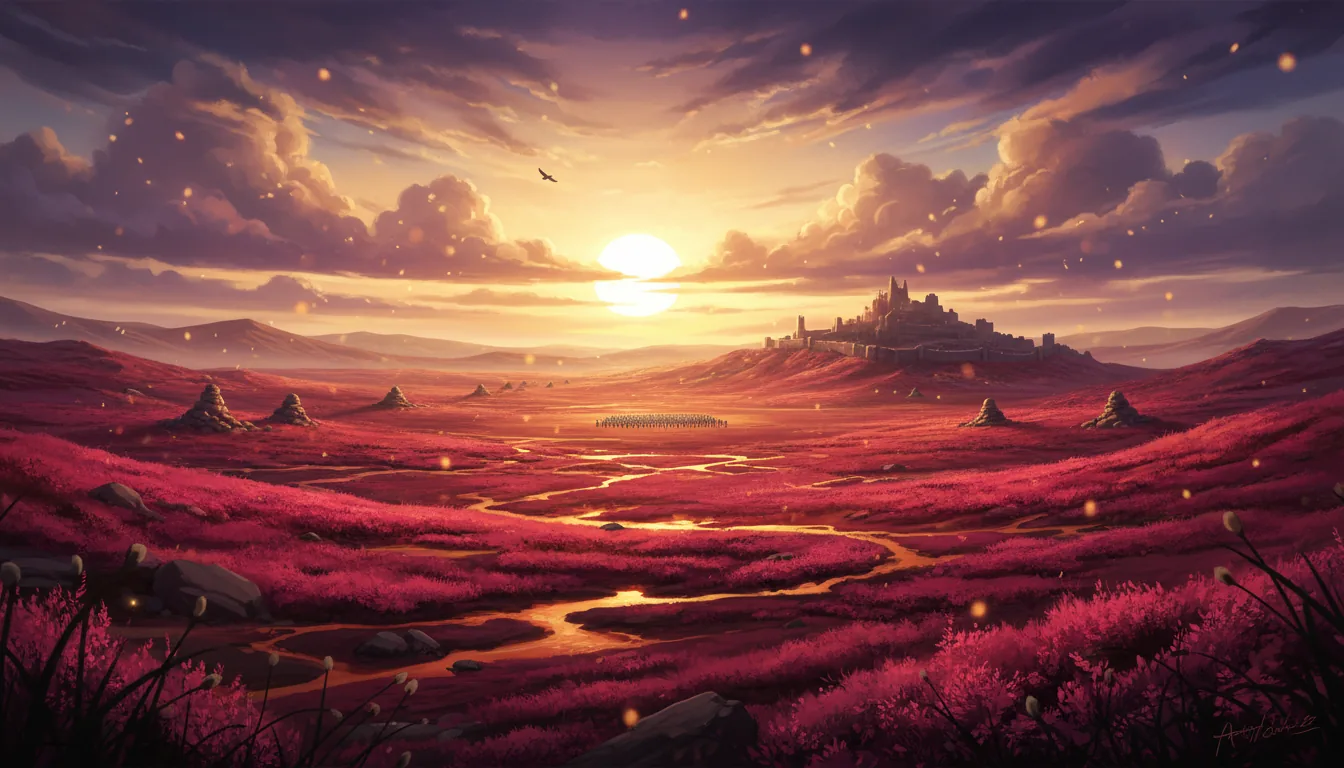
Open, wind-scoured upland of heather and red ochre clay, the Redcap homeland and the Wilds' traditional battlefield. Nearly every dispute in the Outer Wilds too large to settle by argument has been settled here, by arrangement, because the ground is good for it and nothing living there objects.
The Land
Treeless, exposed, and drained by shallow ochre-stained streams — the clay that colors the Redcaps' caps and, incidentally, half the Wilds' pottery.
It is the largest open ground in the world at Faerie scale, and that is the whole of its strategic meaning: an army can be seen coming for a day, deployed in formation, and brought to a decision. Everywhere else in either realm, terrain does the fighting. Here it does not, and every people in the Wilds has therefore agreed, without ever signing anything, that the Bloodmoors are where things get settled.
- The wind. Constant, and hard enough that unaided flight over the open moor is not attempted. Redcaps are wingless and find this funny. Faerie envoys walk, which is precisely the point of holding negotiations here.
- Exposure. No shelter, no wood, and weather that comes across forty kilometers of nothing. The Bloodmoors kill more travelers by cold rain than by anything with a weapon.
- The ochre bogs. Rust-red pools in the low ground, deep, soft-bottomed, and preserving: things that go in come out centuries later intact. This is the province's archaeology and its most reliable source of nightmares.
- Hawks. Gargantuan, and the open moor is their hunting ground. Every Redcap column moves with spotters and a shield-drill, and a party crossing without either is not a party, it is a delivery.
- Iron ground. Bog-iron nodules form in the ochre streams in quantities found nowhere else, which is why the province that produced the Kingdom's least favorite people also produced the one substance that troubles Faerie magic.
Flora and Fauna
| Feature | What it is | Why it matters |
|---|---|---|
| Heather | The whole surface, a knee-high forest of it | Fuel, thatch, bedding, and cover for anything crawling |
| Bog-iron | Nodules gathered from the ochre streams | The Redcap economy; the Kingdom's quartermasters call it a problem |
| Ochre clay | Red, everywhere, and mildly antiseptic | Dye, pottery, the caps, and field medicine |
| Cottongrass | White-headed, marks firm ground from bog | Navigation. Ignoring it is how you become archaeology |
| Moorwort | Bitter root that keeps in cold | The winter staple, and it is genuinely awful |
| Hawks | Gargantuan; thread cover at speed | The apex. The spotters' whistle is the most important sound here |
| Grouse | Colossal; ground-nesting, explosive, stupid | Not a predator. Will still flatten a column that startles it |
| Bumblebees | Small; nest in the moor, placid, valuable | The Bloodmoors' air freight, and the only sweet thing here |
| Ground beetles | Tiny; night, jaws, chemical spray | Common enough that Redcap children are taught the smell |
The Iron Barrow
The largest standing force outside the Kingdom is quartered here, in the only ruin in the Wilds that has been continuously occupied rather than reclaimed: a fortress dug into a hillside, whose lowest levels are visibly older than its upper ones and are built of worked iron — a material no Faerie could have laid.
The Redcaps have never explained this. It is possible they do not know either.
Other Settlements
Ochrewater (4,000) — the bog-iron works: gathering-crews, bloomeries, and the smiths who make the Wilds' weapons. It is downwind of the Barrow and everything in it is red.
The Standing Ground (seasonal, up to 20,000) — not a town but a place that becomes one: the arranged-combat field, with its terms-tents, judges' posts, spectator banks, and a seasonal market that outsells anything in the Wilds except the Sump.
Cottonmarch (2,500) — a bog-edge village of turf-cutters and bog-walkers who guide columns across the low ground. They are the only people who know the safe lines and they have never written them down.
Hollow Ninth (1,800) — a Redcap village built into a ruin nobody can identify, on the Barrow's model, and one of a dozen such. The Wilds are full of these. Nobody counts them.
Factions
The Jarl's Muster. Gorrach's standing force: the largest army outside the Kingdom, drilled, provisioned, and available to the Great Hunt on demand. It is also the province's employer, court, and road authority.
The Term-Keepers. Judges of arranged combat: they negotiate the terms beforehand and enforce them afterward, and their authority is accepted across the entire Wilds. A Term-Keeper's ruling has never been successfully defied, which says less about their power than about what everyone else believes it would cost.
The Bloomeries. Ochrewater's smith-houses, who set the price of iron and therefore of war. Formally loyal to the Jarl. Commercially loyal to whoever is buying, including — through three intermediaries and a Rimeward factor — the Kingdom.
The Unsworn Bands. Redcaps who have not taken the Jarl's oath and hire out individually: caravan work, feuds, and the occasional job in the Kingdom that a Faerie cannot be seen doing. Gorrach tolerates them because they are a pressure valve and because half of them come back.
The Cap-Makers' Silence. A small, deadly-serious guild who dye the caps and who know that the story about the blood is a story. They have kept it for centuries, they will keep it, and they consider anyone investigating it to be conducting a form of attack.
Sites of Interest
The Iron Levels. The bottom four floors of the Iron Barrow: worked iron, laid as construction rather than forged as tools, in a technique nobody now living can reproduce, and predating everything above it. Redcaps quarter there because it is dry and defensible, and because the walls do something to Faerie magic that has saved the fortress twice. What it was, who built it, and why it is full of doors sized for something taller than a Redcap are questions Gorrach has publicly declined to fund.
The Standing Ground. A mile of level heather with a judge's post at each end, where the Wilds settle what cannot be argued out. The rules are old, exact, and honored: terms negotiated beforehand, terms kept afterward, no pursuit, no reprisal. The Kingdom's histories describe Redcaps as savages and do not mention that the Wilds have a functioning institution for war and the Kingdom does not.
The Ochre Bogs. Red pools in the low ground that preserve whatever falls in. Bog-walkers pull things out for a living: weapons, armor, wagons, and bodies — well-dressed, undecayed, centuries old, wearing Faerie work in styles that appear in no Kingdom record. There is a shed at Cottonmarch with eleven of them in it. The village has stopped bringing more up.
The Sky-Watch Cairns. A chain of stone posts across the open moor, each manned in daylight, each within whistle-range of the next: the hawk warning system, four hundred years old, run continuously by a rota that has never lapsed. It is the single most impressive piece of civil infrastructure in the Outer Wilds and it was built by people the Kingdom calls incapable of building.
Hooks
- A Kingdom herald has arrived to demand the Barrow surrender a fugitive. Gorrach's answer will be an arranged combat under Term-Keeper rules. The herald has never heard of Term-Keeper rules and has been given a champion's place he cannot decline.
- Cottonmarch will pay to have the shed emptied — quietly, respectfully, and by outsiders, because the eleven bodies in it are wearing livery that half the village has started to recognize.
- The Bloomeries have received an order for iron in a quantity that only makes sense as a siege train, paid in Kingdom coin, through a Rimeward factor who has never handled iron before.
- Something is coming up through the floor of the Iron Levels. It is not water.
- A Sky-Watch cairn has gone silent, and the two cairns either side of it report that the watcher is still standing there, still on post, and no longer answering.
Relations
The Bloodmoors are the Goblin King's military backbone and the reason the Queen's generals speak more carefully in private than in public. Arranged combat here is governed by terms negotiated beforehand and honored afterward, an institution the Kingdom's histories decline to mention when describing Redcaps as savages.