The Rustlands
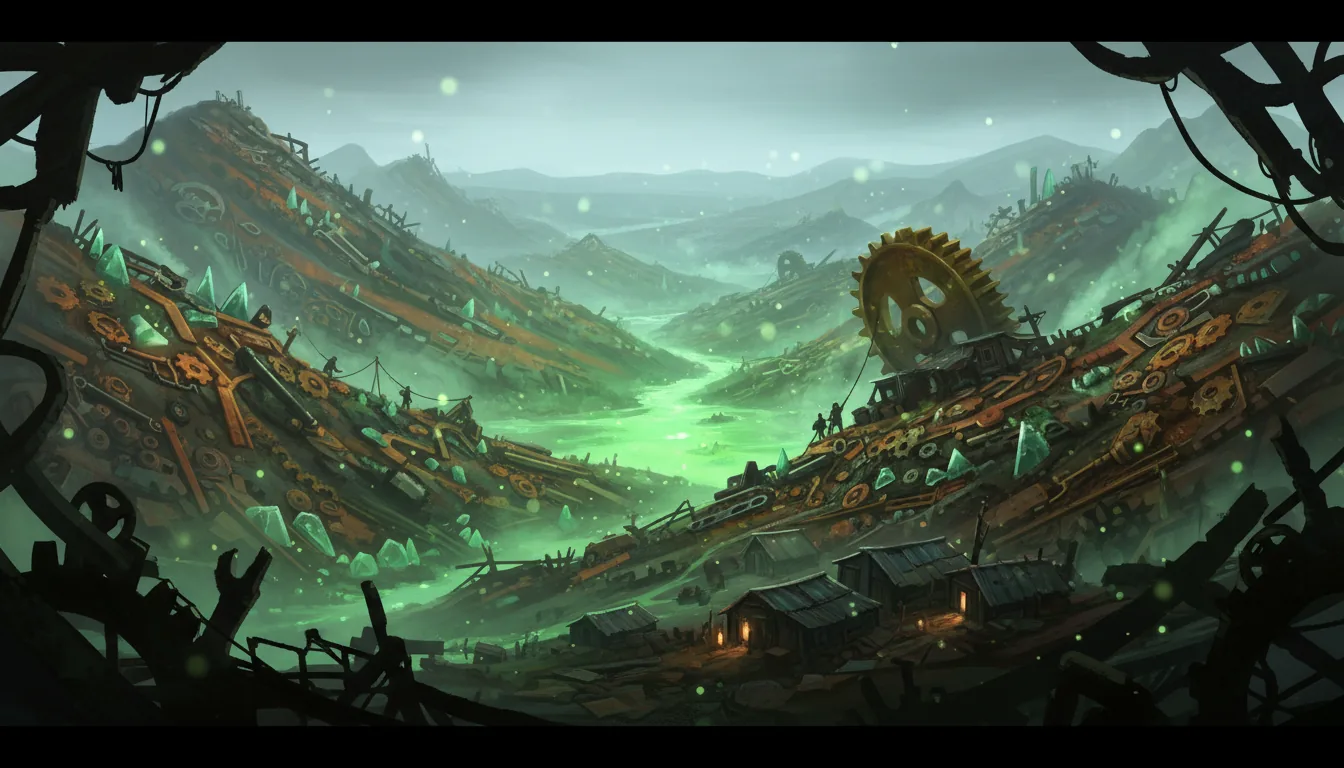
Where the Kingdom's refuse goes. Centuries of broken artifice, spent tools, failed clockwork, and discarded construction have piled into a range of scrap hills, leaching strange chemistries into the soil and growing stranger plants. It is toxic, unstable, constantly shifting, and the gremlins love it.
The Land
Hills of layered refuse, dated by stratum the way a geologist dates rock. A Rustlands salvager can place a find within a century by what it was buried under, which makes the gremlins the only people in either realm keeping an accidental archaeological record of the Kingdom.
There is no natural ground here. The whole province is artifact: a range of hills two hundred feet high made of everything the Kingdom has ever thrown away, still settling, still reacting, still — in places — running. Water goes in clean at the Rimeward end and comes out the other side as something that has to be labeled.
- Collapse. The heaps subside without warning. Salvagers work in threes with a line and a listener, and the Sump's death-rate is discussed the way weather is discussed elsewhere.
- Leachate. The valleys between the heaps pool with runoff of no fixed composition. Some of it is merely poison. Some of it dissolves iron, some glows, and one pool in the eastern range has been on fire for eleven years.
- Fume days. When the wind drops, the heaps exhale. Everyone goes high or goes under a wet cloth, and the province simply stops for a day or two at a time.
- Live salvage. A great deal of the Kingdom's discarded artifice was thrown away because it did not work correctly, not because it stopped working. Things down there are still wound, still charged, still holding pressure, and a fair number of them are still following their last instruction.
- The strange growth. The chemistry has produced flora found nowhere else, most of it useless, some of it extraordinary, and all of it slightly wrong in a way that unsettles visitors and delights the Briar Barrens apothecaries.
Flora and Fauna
| Feature | What it is | Why it matters |
|---|---|---|
| Rustweed | Iron-eating creeper that stabilizes a slope as it grows | Deliberately planted; the only reason some heaps stand |
| Slagbloom | Flowers on leachate margins; petals are actual glass | Beautiful, worthless, and the province's only souvenir |
| Tallow-fungus | Grows on spilled lubricant, renders down to lamp oil | Lights the Sump |
| Bitterroot | Drinks leachate, concentrates it, and survives | Pukwudgies buy every scrap. It is in half the Wilds' poisons |
| Ironworm | Large; earthworms adapted to metal-rich spoil | The heaps' tunnelers, and the salvage crews' partners |
| Rove beetles | Diminutive; carrion and chemical burns | Thrive here. The raised tail means don't |
| Cockroaches | Tiny; eat anything, survive anything | The province's most numerous citizens and its best guides |
| Gearlings | Not alive. Wound artifice that never ran down | Nobody agrees what these are. They have preferences |
The Sump
A valley where the runoff pools and gremlin salvagers gather to trade parts and information. Camps move as the heaps collapse, which is often; the Sump persists because the water does.
Other Settlements
Cinderdrift (3,000) — the smelters, at the province's downwind edge, where salvage is reduced to material. Everything there is grey and everyone there is rich by Wilds standards.
Tallowlight (2,000) — a fungus-farming camp built entirely inside a collapsed heap, warm and lit and reasonably safe, whose residents have not been outdoors in years and consider this a lifestyle.
The Cut (1,200) — a trading post on the Rimeward road where gremlin factors meet Bellowsgate's buyers. Both sides pretend the trade is small. The road is deeply rutted.
Pickers' Camps (transient, uncounted) — dozens of them, moving with the heaps, mostly Basekin crews working salvage the gremlins subcontract. The gremlins pay them, which is more than the Kingdom did.
Factions
The Warden's Office. Nix and the salvage-wardens: they license digs, arbitrate claims, and keep the strata record. It is the only government in the Wilds that maintains an archive, and it does it for commercial reasons.
The Deep Cut Syndicate. Salvagers who work the oldest strata, where the finds stop being Kingdom refuse and start being something else. High-paying, high-mortality, and increasingly secretive about what they are bringing up.
The Bellowsgate Trade. The Rimeward buyers and their gremlin counterparts. The Kingdom's only real commerce with the Wilds, entirely undocumented, and worth more annually than the Emberwaste's glass.
The Tinkers' Free Bench. Gremlin artificers who repair, recombine, and improve — and who have started producing things the Winterworks has not invented yet. This is not yet widely known outside the province and will be a serious problem for somebody when it is.
The Quiet Wind. A small faction who believe the province should stop selling and start keeping: that a century of retained salvage is an arsenal, and that the Wilds will need one. Nix has not endorsed them and has not stopped them.
Sites of Interest
The Strata Record. The Warden's archive at the Sump: four hundred years of what was thrown away, when, and by whom, indexed by heap and depth. It is a complete material history of the Faerie Kingdom compiled entirely from its garbage, and it contains — because garbage does not lie — evidence of at least three things the Chancery's official record denies, including a decade in which the Kingdom disposed of a very great deal of iron.
The Eleven-Year Fire. A leachate pool in the eastern valleys that caught and has not gone out. It burns green, it burns without fuel anyone can identify, and the ground around it is the healthiest in the province — rustweed grows thick there, and the pickers who work its margins are noticeably long-lived, which is either extremely good news or the setup for something.
The Deep Cut. Where the oldest strata are exposed: below the Kingdom's refuse, below the layer where the styles stop being recognizable, into material that was buried before anyone was throwing anything away. The Syndicate works it under an exclusive license and has stopped filing finds with the Warden's Office. Nix has noticed. Nix has not acted, which is unlike her.
The Wound Yard. A fenced compound at the Sump where live salvage is kept until it runs down. Some pieces have been in there for two centuries and are still going. They are not dangerous, exactly — they are purposeful, and several of them are clearly trying to complete a task, and one of them has been slowly, patiently digging.
Hooks
- A Winterworks factor at the Cut wants a specific item found: a sealed pressure vessel, discarded ninety years ago by order, and the order is the only part of the story he will discuss.
- The Deep Cut Syndicate is hiring outside labor, which they have never done, and the contracts are for one dig only and include a confidentiality clause enforced by the Term-Keepers of the Bloodmoors.
- The Wound Yard's digger has broken through into something. It has stopped digging and is now, as far as anyone can tell, waiting.
- Fume days have come three weeks early and are not lifting. Tallowlight has not answered in six days.
- A Tinkers' Free Bench artificer wants to sell a working prosthetic wing — better than Winterworks issue, made of scrap, made by a goblin — and needs someone to take it to market in the Kingdom without being killed for it. Everyone involved understands what this device means for the doctrine.
Relations
Everything of value in the Outer Wilds that cannot be grown or dug comes out of here, and the Winterworks buys most of it while maintaining that it does not.