The Hollow Marches
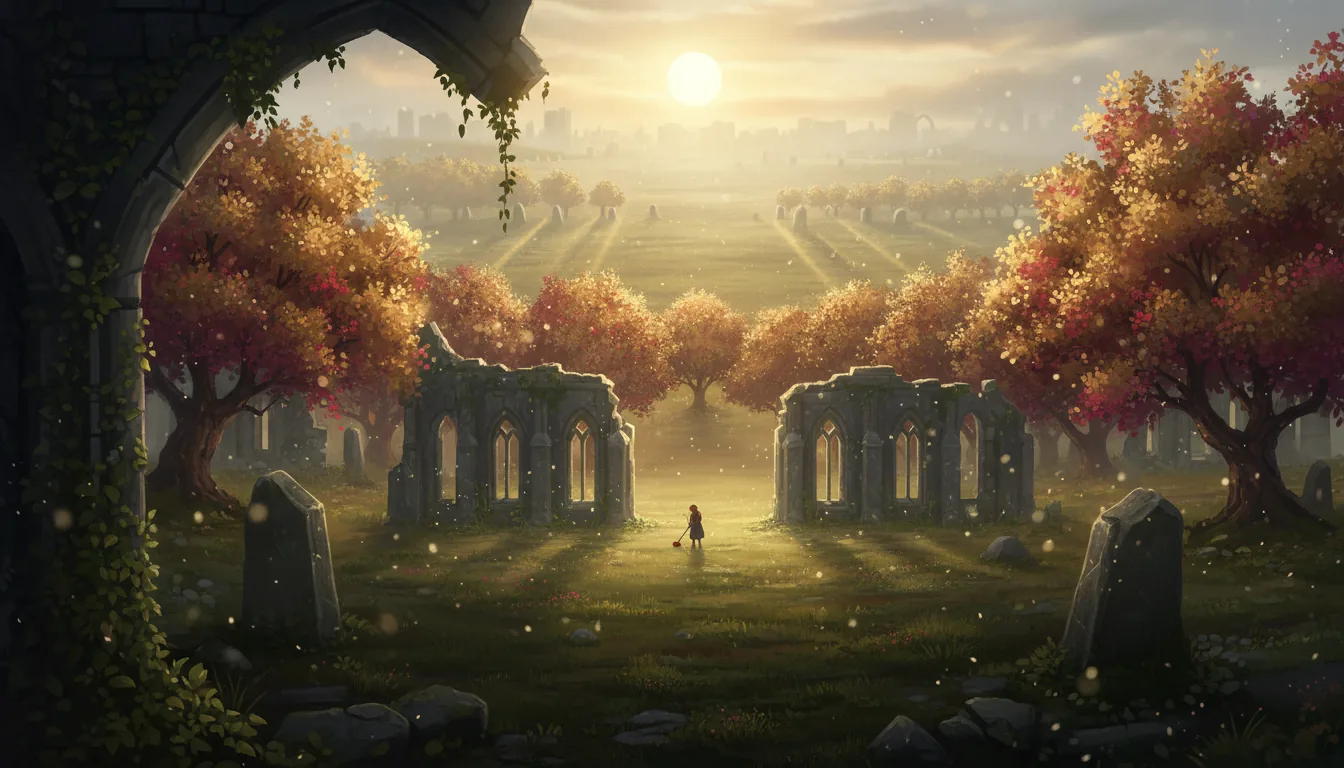
The ruin-country: a broad belt of collapsed halls, choked orchards gone feral, road-traces, and boundary stones with names on them that appear in no Kingdom record. Whatever stood here was Faerie work and it was extensive.
The Marches are the strongest evidence that the Kingdom is a successor to something larger, and the court's flat refusal to investigate them is itself worth a campaign.
The Land
Broken stonework under two or three centuries of growth, distributed too evenly to be a single city and too densely to be anything but continuous settlement. The boundary stones are the worst part: they are legible, they are in a recognizable hand, and the names are of nowhere.
The landscape is a landscape of rooms: walled enclosures gone to meadow, orchards that were planted in rows and have spent centuries forgetting them, avenues under sod, and cellars. An enormous number of cellars. The wild here is not wilderness — it is a garden that has been unattended for a long time, and it still shows the plan.
- Collapse. Nothing here has been maintained in centuries, except by boggarts, and boggarts maintain what their habit dictates rather than what is load-bearing. A hall with a swept floor and a tended gate can drop its roof on you.
- The feral orchards. Planted rows gone wild and grown enormous, fruiting in quantities nobody harvests, and the fermenting drop draws everything for miles. An orchard in autumn is the most dangerous place in the province and the best-fed.
- The quiet. Fifteen thousand people in a hundred square kilometers, and nearly all of them alone. Travelers consistently report the Marches as oppressive in a way they struggle to name, and the thing they are struggling to name is that the land was built for a great many more people than are in it.
- Undercroft. The cellars connect. Not everywhere, and not by design that anyone can reconstruct, but a survey party that goes down in one holding has repeatedly come up in another, and the boggarts use the routes without ever having explained them.
- No hunting parties. The Great Hunt rides around the Marches, never through. The Goblin King has never given a reason and has never been asked twice.
Flora and Fauna
| Feature | What it is | Why it matters |
|---|---|---|
| Feral orchards | Planted rows gone wild; enormous, over-fruiting | Autumn drop feeds the whole province and attracts everything else |
| Hall-ivy | Cultivated species gone rampant, prying stone apart | The Marches are being disassembled by a garden plant |
| Kingsfoil rows | A cultivated herb still growing in its beds, unattended | Somebody planted these. The beds are still square |
| Cellar moss | Grows only in the undercrofts; maps the connections | Follow the moss and you follow the airflow |
| Boundary stones | Cut, lettered, legible, and naming nowhere | The single most disturbing artifact in either realm |
| Rats | Huge; clever, organized, negotiate in good faith until they don't | The Marches' largest population by a distance, and they remember |
| Foxes | Colossal; cunning enough to be a person | Hunt the orchards. Everyone gives way |
| Owls | Gargantuan to Colossal; the ruins are ideal nesting | Every tower is occupied. This is why nobody rebuilds the towers |
| Beetles and woodlice | Fine to Small; the reclamation crews | They have been eating the evidence for three centuries |
The Witnesses
Boggarts live in the ruins, one to a holding, and are the only living witnesses to any of it — except that boggarts, like all fey, lost their memories at metamorphosis, and what they have instead are habits: sweeping a hall that has no roof, keeping a gate in a wall that has no other side.
A great deal could be reconstructed from watching them, if anyone thought their behavior worth watching.
Settlements
There are no settlements. There are holdings: one ruin, one boggart, one set of duties nobody assigned. The following are exceptions only in that more than one person is present.
The Nameless Hall — the largest ruin in the Marches and the Steward's own: a hall complex of perhaps forty rooms, swept daily, gates kept, hearths laid and never lit, in which the Steward has served an absent household for as long as any record runs. Nine other boggarts have attached themselves to it. None of them can say why.
Orchard Ninth (~200) — the one place in the Marches with a market, held at the largest feral orchard during the drop, attended by boggarts, rats, and traders from three provinces, for eleven days a year.
The Steward's Road — a road-trace kept clear, all forty kilometers of it, by the boggarts whose holdings adjoin it, each sweeping their own stretch, none of them coordinating.
Rat Corporation of the Undercroft (uncounted) — an organized rat polity in the connected cellars, with officers, contracts, and a long institutional memory. They will talk terms with anyone. They are the best-informed residents of the province and nobody in either realm has thought to ask them anything.
Factions
The Steward's Household. Nine boggarts and a Steward serving a family that has not existed in centuries, in a hall with no roof over half of it. It is the only institution in the Marches, and its function is to keep doing what was being done.
The Rat Corporation. The undercroft's polity: contracts, tolls, and a written record going back further than anything the Kingdom will admit exists. They trade access to the cellar routes for food and for salvage rights, and they have been quietly assembling an archive of what they find down there.
The Chancery's Silence. Not a faction present in the Marches — a faction about them. Somebody in the Eternal City has, for four hundred years, ensured that no expedition to the Hollow Marches is chartered, funded, or reported. Three heralds have tried. All three were promoted.
The Antiquarians. An informal, illegal, and enthusiastic network of Leprechaun surveyors, Gnome moot-clerks, Gremlin strata-keepers, and one Wisp astronomer, who have realized that their separate anomalies are the same anomaly. They correspond in code and have never all been in one room.
The Hunt's Avoidance. The Goblin King's standing order that the Great Hunt does not enter the Marches. It has been in force since before Gorrach's time. Nobody knows the reason and precisely one person has ever asked.
Sites of Interest
The Nameless Hall. Forty rooms of swept floor, laid hearths, and kept gates, maintained without pause for an unknown number of centuries by a boggart who cannot say for whom. The place-settings in the great hall are laid every evening for a specific number of people, and the number does not change, and it is not a number that means anything to anybody. The Steward will receive guests with complete courtesy, will answer any question that can be answered, and becomes distressed only when asked whose hall it is.
The Boundary Stones. Cut, lettered stones at regular intervals over a hundred square kilometers, in the Chancery's own conventions, giving distances to places that do not exist. The lettering names nine holdings and one seat. The Kingdom has twelve provinces and one seat. The Antiquarians have plotted the distances. They converge on a point in the middle of the Marches where there is nothing at all, and where the ground is very slightly domed.
The Undercroft. The connected cellars: cool, dry, structurally better than anything above them, and running further than any survey has followed. The Rat Corporation controls access, charges for it, and has drawn — in their own notation, on their own charts — a map that is the single most valuable document in the world, and which they will show to anyone who asks politely and pays.
The Domed Ground. Where the boundary stones' distances converge: a low rise in a meadow, unremarkable, with no stonework showing. Cellar moss grows in a ring on it. The Steward sweeps a path to it and has done so, without interruption, for as long as anyone has known him, and cannot say why, and does not like to be there after dark.
Hooks
- An Antiquarian needs someone with no institutional loyalties to carry a full set of boundary-stone measurements to Lumenhal for plotting against the astronomical record.
- The Rat Corporation is prepared to sell the undercroft map. Their price is a legal instrument — signed by a Kingdom authority, in a form a Kingdom court would honor — recognizing their corporation as a party capable of holding a contract. That instrument does not exist and cannot be issued to a rat.
- The Steward has begun laying one extra place at the table.
- A Chancery expedition arrives in the Marches for the first time in four hundred years, well-funded, well-armed, with orders nobody will show, and its first act is to post a guard on the domed ground.
- Every boggart in the Marches stops, at the same moment, on the same day, and then resumes — except that eleven of them have changed what they do.
Relations
None. The Marches are avoided by the Wilds and denied by the Kingdom, which is the only subject on which the two governments have ever fully agreed.