The Heartland
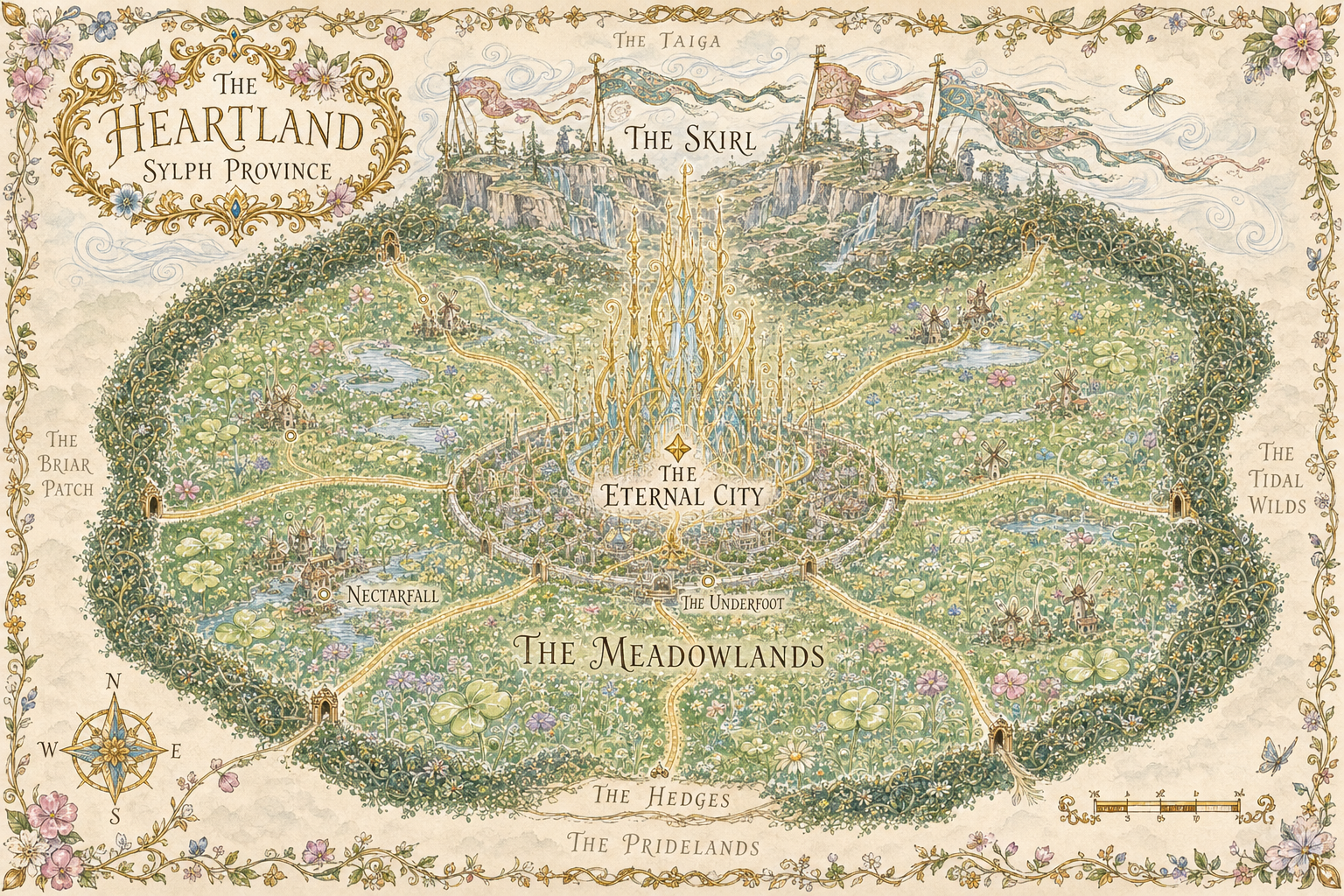
The Sylph province at the center of everything, named for the winds that never quite stop moving across it. The Heartland are three countries wearing one name: the Meadowlands, the vast rolling plains that make up most of the province by land area; the Skirl, the high, windy vales of the northern rim where the old Sylph ways persist; and the environs of the Eternal City itself, which belongs to the Crown and yet sits in the province like a stone in fruit. Every road in the Kingdom is measured in distance from here.
The Meadowlands are waist-high grass, which is to say forests of it, clover the size of parasols, and wildflower country that changes color three times a season — the most temperate and forgiving land in the world, and it is no accident that the race which holds it became the most numerous and the most favored.
The Land
Open meadow with slow water and gentle relief, ringed almost entirely by the Hedges and rising along its northern rim into the Skirl — chalk downs and hanging vales where the wind comes off the Rimeward heights and never stops. The Nine Roads run inward to the capital from every province, and are the only formal infrastructure the Kingdom maintains at its own expense.
Navigation in the plains is done by windmill. Every Meadowlands village raises one — part granary, part press, part signal-tower — and their sails are visible over the grass canopy for miles, so that a traveler crossing the open meadow steers from mill to mill the way a sailor steers by lights. In the Skirl there are no mills; there are the banners, long woven streamers flown from the vale-heads, and the Sylphs who fly them can read weather, news, and mourning off a neighbor's ridge at a glance.
At Faerie scale the grass is a canopy. A stand of meadow fescue stands eighty feet over the road, the light comes down green and moving, and half the province's navigation is done by counting stems. Above it all the flower-heads open at heights no ground traveler will ever reach, which is why the Sylphs — who can, in bursts — regard the Meadowlands as theirs in a way no map records.
The forgiving climate is genuinely forgiving, and this is worth stating plainly: nowhere else can a Faerie sleep in the open, eat what is growing where they stand, and expect to wake. The dangers here are not privations but events.
- Dewfall. Every clear night the meadow grows a second landscape of water. A dewdrop the size of a cottage clings to a grass blade until something disturbs it, and then it falls, and surface tension does the rest — a Faerie caught in one does not drown so much as fail to get out. The dew-watch is a real profession and the drowning season is real.
- The Gild. For three days at the height of summer the wildflower flush produces more nectar than the whole province can carry. Everything gets drunk. Beetles stagger, herds wander, the courts adjourn, and the Kingdom's most incautious decisions have historically been made in the second week of the Gild.
- Pollen storm. A dry wind through a dandelion stand fills the air with gold, blinds everything, chokes wings, and buries a road two feet deep by morning. Caravans wait it out with cloths over their faces and lose the schedule.
- Rain. A raindrop at this scale arrives like siege shot. Storm season is spent under cover, and the Kingdom's roads are built with drum-shelters at intervals for exactly this reason.
Subregions
The Meadowlands. Rolling plains and farmland across most of the province, worked by the Pixies, who spend as much of the year at festival as at harvest. The Nixies, an Undine tribe, hold its freshwater lakes and waterways.
The Skirl. Windy chalk highlands along the northern rim, where the Aurae keep the old Sylph ways, weave banners that make the wind visible, and fly better than any Faerie alive.
The Eternal City. The Queen's seat and the capital of the Kingdom, dominated in number by the Flaunt and in rank by the High Sidhe.
Flora and Fauna
| Feature | What it is | Why it matters |
|---|---|---|
| Parasol clover | Broad three-leafed shade, forty feet across | The province's roof, its shelter, and its most common address |
| Nine-road fescue | The great grass; the canopy layer | Stems are milestones, ladders, and lumber |
| Honeywort | A nectar bloom that yields year-round | The Meadowlands's cash crop, pressed at Nectarfall |
| Thunderbloom | Opens only in storms, sap carries a charge | Leprechaun buyers pay absurdly; harvest kills a few every year |
| Sleepgrass | Sweet, common, and a mild soporific in quantity | Herds fed on it are docile, which everyone finds convenient |
| Aphid herds | Fine, placid, milked for honeydew | The oldest livestock in the world; they know their own names |
| Rhinoceros beetle teams | Medium draft, four to a nectar wagon | The Nine Roads move because they pull |
| Grasshopper post | Small courier mounts, fifty-foot bounds | Fastest legal way across open meadow |
| Ladybird beetles | Diminutive, red, charming, ravenous | The reason aphid herds need armed guards |
| Robber flies | Tiny, fast, aerial | Take couriers out of the air and eat them on the descent |
Society
The Meadowlands are the Kingdom's breadbasket and its parade ground. Nectar, seed, and pollen flow inward along the Nine Roads, carried in caravans of harnessed beetles and worked by non-Faerie labor that the Kingdom's ledgers list as equipment. The province's three ways of being a Sylph — the Aurae of the Skirl, the Pixies of the plains, and the Flaunt of the capital — are covered under the Sylph entry, and agree on almost nothing except the wind.
It has no Sylph capital, because the capital is the Eternal City and the Sylphs surrendered any separate identity to it long ago. This is the source of their "first among equals" standing and of a quiet melancholy running through Sylph culture: every other race can point at a place and say that is ours, while the Sylphs can only point at the Queen's city and say we live nearest.
Settlements
The Heartland have no capital and never will; the capital is the Eternal City, sitting in the middle of the province like a stone in fruit. What they have instead are road-towns, each grown up around one job, and beyond the towns the windmill villages of the Meadowlands — clusters of a few dozen households around a mill, a press, and a market yard, where the farmers of a day's radius come to trade.
Nectarfall (18,000) — the press-town, built downhill of the honeywort flats so the syrup runs where it is wanted. Everything smells of it, permanently, and the pressing guilds are the wealthiest commoners in the Kingdom.
Chaffhold (11,000) — seed granaries in tiered drums, staffed almost entirely by Basekin crews and administered by three Sylph clerks who have never gone inside one.
Milkbarrow (7,000) — the aphid pastures, and the drovers' town that runs them. If you want to know what the province actually thinks, drink here and not in Nectarfall.
Ninebridge (9,000) — the last posting station before the capital, where every inbound caravan is weighed, taxed, inspected, and delayed. More of the Kingdom's business is transacted in Ninebridge's waiting yards than at court.
Vanehigh (2,000) — the only thing in the Skirl that resembles a town: a saddle between two vale-heads where the Aurae hold their seasonal moots, hang the great banners, and trade wool, weather-word, and weaving with the plains below. It has no permanent buildings the wind is not allowed to pass through.
Factions
The Wardency of the Nine Roads. Duke Aureling's road-wardens: tolls, escorts, caravan schedules, and the ledgers. Correct, popular, and the single largest employer of armed Faeries outside the capital's own guard.
The Drovers' Concord. An unchartered guild of teamsters, ostlers, and herd-hands, Faerie and Basekin together, who have worked out that nothing reaches the Ring unless they walk it there. They have never struck. Everyone in the Wardency knows precisely how bad it would be if they did, and the Concord knows that they know.
The Spill. Road-thieves with a story about themselves: they take only what the ledgers list as spillage, and they hand a good deal of it to whoever the ledger lists as equipment. Half the province thinks they are heroes and the other half has had a wagon robbed.
The Ledgerless. A quiet cell of Wardency clerks copying caravan manifests, name by name, into a second set of books where the crews are people. The books have no legal standing whatsoever. They are the most dangerous documents in the Kingdom.
Sites of Interest
The Waystone. Where the Nine Roads meet, three miles out from the capital's gates: a single monolith of grey stone, older than the roads it measures, from which every distance in the Kingdom is reckoned. Touch it and you know, without ambiguity, how far you are from home — a working the Kingdom did not build and cannot repeat. Pilgrims come to be certain of something. So do deserters, who find out how far they have not gone.
The Gild Meadow. A wildflower flat, forty acres of it, that carries the summer flush hardest. During the Gild it is impassable with drunk fauna and joyously mobbed by everyone who can walk. The rest of the year it is empty, and at its center is a ring where nothing grows and the ground reads slightly warm to the hand. Nobody has excavated it. Everyone has a theory.
The Model Farm. Aureling's demonstration estate, where the Kingdom's agriculture is done properly for the benefit of visiting nobles: clean pens, singing crickets, contented aphids, a herd that comes when called. The books are immaculate. A second set exists, because the first set does not balance with the number of workers actually fed, and somebody at the Model Farm has been quietly making up the difference out of their own pocket for eleven years.
The Drowned Acre. A shallow basin where the dew pools instead of draining and does not burn off until noon. Two caravans are down there, one of them recent. Salvage is legal, straightforward, and has killed everyone who has tried it in the last decade, because the water sits under a skin that will hold a Faerie's weight right up until it does not.
Hooks
- A Drovers' Concord speaker asks the party to escort a wagon that carries no cargo. It is a test — of the road, of the wardens, and of whether the Concord can move something without being seen doing it.
- The second ledger has gone missing from the Model Farm. The clerk who kept it has fled toward the Hedges. Three parties are looking: the Wardency, the Spill, and someone from the Ring who is paying far too much.
- The Gild starts eleven days early. The flowers are wrong about the season, the herds are wandering, and the Dryads of the Greenmantle have sent a message about it, which they have not done in ninety years.
- A ladybird raid on the Milkbarrow pastures was too organized to be a raid. The aphids say so. Nobody official will take a statement from an aphid.
- The Waystone gives a wrong answer — the same wrong answer — to everyone who touches it for one full day, and the distance it reports matches nothing in the Kingdom.
Relations
Politically inseparable from the capital, which is exactly the problem. The Meadowlands's harvest feeds the Ring's estates, its people staff them, and its province has no voice at court distinct from the crown's own.