Sylph
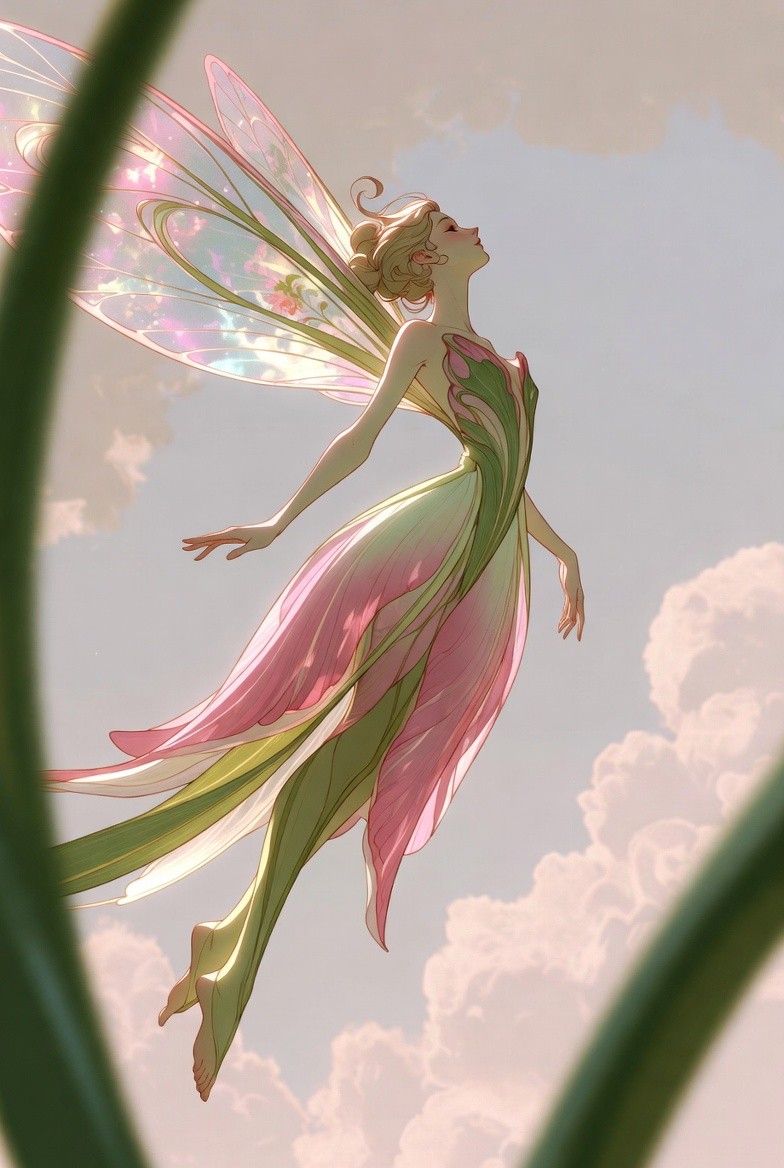
The Sylphs hold the Heartland at the center of the world, and the heart of it — the Meadowlands — is the most forgiving country there is. Warm, well-watered, thick with clover and seed and pollen, it asks nothing of the people who live in it, and the Sylphs have accordingly become the most numerous, the most peaceable, and the most favored of the twelve races.
They are also the only race with no home of their own. The capital sits in their territory, and over the centuries the Sylphs surrendered any separate identity to it. This is the source of their standing and of a quiet melancholy that runs all the way through their culture: every other race can point at a place and say that is ours, while a Sylph can only point at the Queen's city and say we live nearest.
Appearance
Slight even by Faerie standards, with pale colouring that runs to grass-green and wheat-gold, and the longest, narrowest wings of any race — so thin they are nearly invisible at rest and produce almost no sound in flight. A Sylph in the air is the closest thing in the world to silent.
They are also the race the court holds up as the model of correct lesser-Faerie appearance: sylvan enough to know their station, humanlike enough to serve in a noble house without comment. Sylphs are aware of this and have complicated feelings about being the acceptable ones.
Attuned Magic
Air. A nascent Sylph stirs breezes and small gusts. With practice the scope grows: sustained winds, weather over a whole meadow, and at the height of the art, localized storms and tornadoes. Sylph flight is the best among the common Faeries, since they can put the air to work rather than fighting it, and Sylph couriers routinely outrun races that are stronger in every other respect.
Everyday use is agricultural and unglamorous: winnowing seed, drying racks, driving pollen off a road, holding a caravan's dust down. The court considers this a waste of a magic and has never offered to do the winnowing.
Life
Villages of woven grass and clover-shade, sited by water, rebuilt after every bad storm season, and rarely more than a few hundred strong. Work is the harvest — nectar, seed, and pollen — and the year runs on it: the flush, the Gild, the drying, the caravans, the long quiet after.
Names. A newly arrived Sylph is named by the village, for where they were found: Fescue, Clover-of-the-Ninth-Field, Dewharrow. It is the plainest naming custom in the Kingdom and Sylphs abroad are often quietly ashamed of it, and change it, and are homesick about that too.
Arrival. A Sylph who has just metamorphosed is walked around their village for a week by a neighbor — shown the water, the fields, the road, the names — and then given work. It is done kindly and without ceremony, and it is the reason Sylph culture is the most sentimental about home and the least able to say what home is.
Song. Sylph folk music is the largest body of song in the world and is overwhelmingly about home. Almost none of it names the place.
Society
Agrarian, communal, and organized around the harvest of nectar, seed, and pollen that feeds the capital. Sylph villages are governed by consensus and old habit rather than by any lord, and the Kingdom's provincial administration is layered on top of that arrangement without ever quite replacing it.
The layer that matters is the Wardency: tolls, caravan schedules, and the ledgers. Sylph villages send their crop, receive their assessment, and have no voice at court distinct from the crown's own — because the crown sits in their province and has never needed to ask.
Tribes
Three countries, three tribes, and a great deal of pretending that the differences are merely regional.
- The Pixies (~900,000) farm the Meadowlands, keep more festivals than the rest of the Kingdom combined, and feed the capital.
- The Aurae (~60,000) keep the old ways in the Skirl: ascetic, devout, banner-weavers, and the strongest fliers of any Faerie.
- The Flaunt (~95,000) are the Sylphs of the Eternal City — fashion, art, and a slim majority of the capital's entire population.
The Flaunt consider the Pixies quaint, the Pixies consider the Flaunt exhausting, and both are careful about what they say of the Aurae.
Currents
The Service Families. Sylphs who staff the Ring by the thousand, generation on generation, and who are the most loyal subjects the Queen has. Their children are raised on the promise that right service metamorphoses upward, and a handful of them have seen it happen, which is enough.
The Drovers' Concord. Teamsters and herd-hands, Faerie and Basekin together, who have worked out that nothing reaches the Ring unless they walk it there. They have never struck. Everyone knows what it would cost.
The Ones Who Have Started Saying It. Sylphs who work the fields alongside crews the ledgers list as equipment and have stopped being able to not notice. Not a movement. A tone of voice, in Milkbarrow, that was not there twenty years ago.
Relations
Close and constant with the High Sidhe, who employ Sylphs by the thousand and regard them with the fondness owed to a favorite servant. Warm with the Cait Sith of the Hedges, who move Sylph produce to market. Strained with the non-Faerie labor that works the Meadowlands fields alongside them and is listed in the Kingdom's ledgers as equipment — a thing many Sylphs have started to notice, and a few have started to say aloud.
Playing One
- The default Faerie, and know it. Doors open. Nobody searches you. This is worth more than any ability and it is the thing the party will keep needing.
- Silent flight, and the air does the work. You are the scout, the courier, and the one who gets there first, in bursts, badly, above open ground.
- You are from the middle of everything and belong to none of it. Every other PC has a homeland. You have a capital that stands in yours.
- A starting complication: somebody in your village is on a manifest as equipment, and you have known them your whole life, and you have just learned what the column means.