The Elderlands
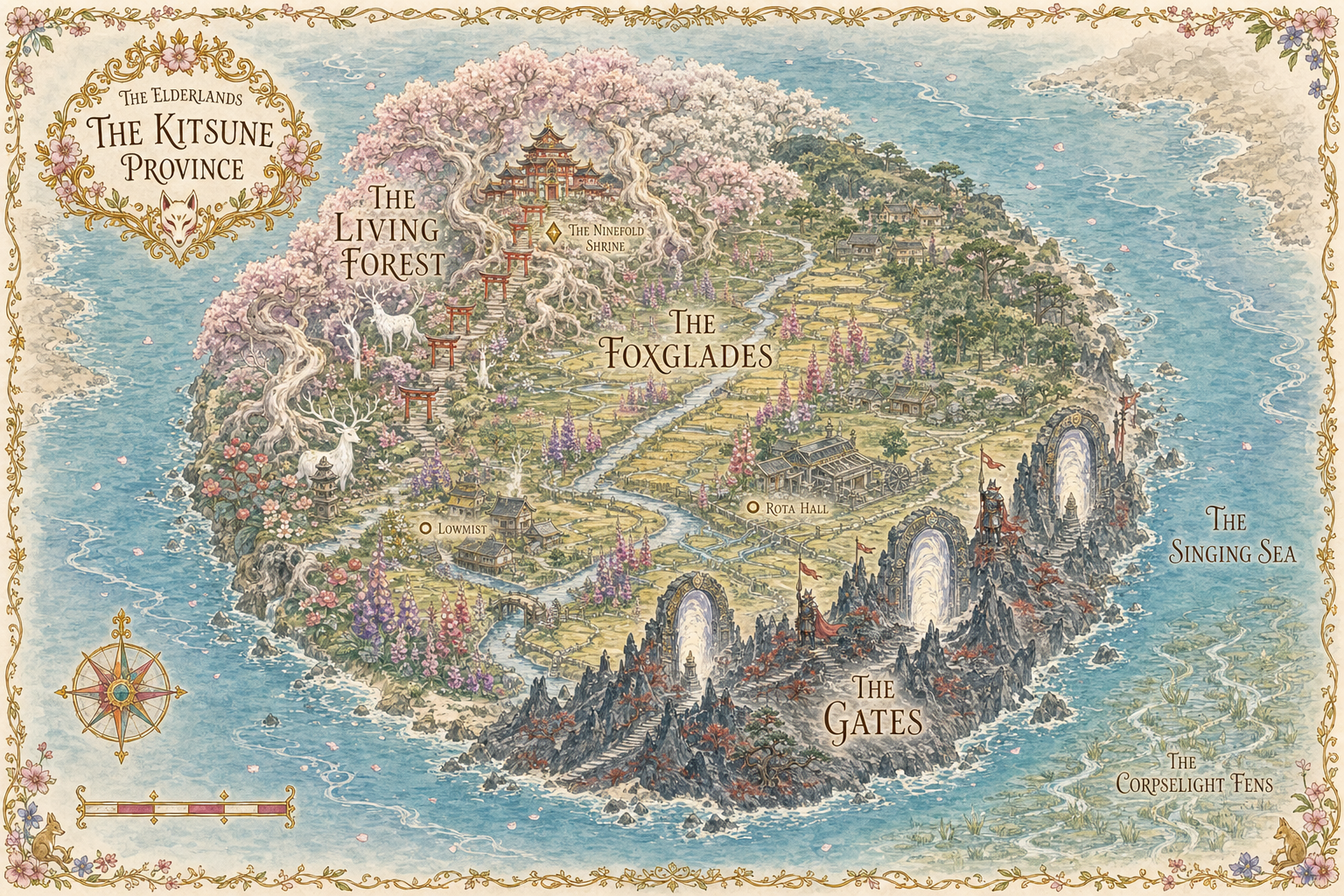
Mist-drowned foothills and stepped valleys on the Kingdom's eastern edge, where shrines outnumber houses and the fog does not lift. The Tenko live here, in numbers far smaller than their influence would suggest.
The Land
Steep, wet, and permanently clouded. The fog is not weather but a fixture, and the Kitsune decline to explain it — which most visitors take as mysticism and which may simply be that they do not know either.
The province is built in steps: terraced valleys climbing from the lowland mist into cloud, every level walled, drained, and planted, the whole thing maintained by a water-management system that is four centuries old and works. It is the most heavily engineered landscape in the Kingdom and it does not look engineered at all, which the Kitsune consider the point.
- The fog. Visibility of thirty feet, most days, everywhere. Sound carries strangely. Faeries flying by instinct fly into things. Every route in the province is marked by rope, by bell, or by memory, and the Kitsune have never been in any hurry to publish a map.
- Storms. The Ninefold is where the eastern weather breaks, and it breaks hard. Lightning is a genuine and frequent hazard, and it is also the Kitsune's attuned element, which produces the province's most characteristic sight: a storm coming in, and figures walking out into it on purpose.
- The terraces. Beautiful, ancient, and lethal if the drains fail. A blocked channel takes out a hillside; the maintenance obligation falls on every household in the province by rota, and shirking it is the closest thing the Ninefold has to a serious crime.
- The quiet. Fewer people live here than anywhere else in the Kingdom, and the effect on visitors is pronounced. Pilgrims describe the province as listening. Residents describe it as empty, and are more accurate and less quoted.
Subregions
The Living Forest. Immortal cherry groves on the island's north-west crescent, tended by the Kitsune, priestesses of Inari and the spiritual soul of the province.
The Foxglades. Terraced paddies and foxglove meadows across the island's centre, where the white and black Kumiho wage an endless war by poison, contract and glamour.
The Gates. Storm-blasted highland studded with planar arches, held against the Netherkin by the Huli Jing alone, and feared accordingly.
Flora and Fauna
| Feature | What it is | Why it matters |
|---|---|---|
| Terrace rice-grass | The staple, grown in flooded steps | Feeds the province with a surplus it gives away, deliberately |
| Mistcap | A fungus that only fruits in standing fog | The tea. Every ritual in the province involves it |
| Stormwood | Timber that survives repeated lightning strike | The gates are built of it and have stood for centuries |
| Bell-vine | Grown along every path; rattles seed-pods in wind | The province's navigation system, planted on purpose |
| Nine-tail fern | Ornamental, ubiquitous, and iconography | Grown at every shrine. Nobody will say whether it came first |
| Fireflies | Tiny; swarm the terraces after rain | The fog lights up. It is the most beautiful thing in the world |
| Frogs | Large; the tongue arrives before the frog does | The terraces are full of them, and they are devout |
| Hummingbirds | Medium; needles on wings, territorial past sense | The one thing here that will pick a fight in a storm |
| Newts | Medium; slow, unbothered, poisonous to the touch | Shrine-keepers, by long custom. It is not a joke |
The Ninefold Shrine
A complex of nine gates ascending a mountainside, each gate marking a step toward whatever sits at the top. The Kitsune are the Kingdom's theologians, and their theology is a problem: they hold that the world was made whole, abundant, and unranked, and that the doctrine of advancement through service is a thing the Faeries invented and then mistook for revelation.
Other Settlements
Lowmist (9,000) — the largest actual town, at the foot of the terraces, where pilgrims arrive and where the province conducts every piece of business it would rather not conduct at a shrine.
Third Gate Village (3,000) — one of eight settlements grown up beside the ascending gates, each named for its gate, each progressively smaller and stranger. Above the Sixth, nobody lives permanently.
Rota Hall (2,000) — the terrace-maintenance authority: engineers, drain-crews, and the water-rota's clerks. It has more practical power than the Shrine and knows better than to say so.
The Frog Chapters (uncounted) — frog communities holding the flooded terraces, with a devotional practice of their own that predates the Kitsune arrival, and which the Kitsune have quietly incorporated rather than replaced. This is the single most subversive fact about Ninefold theology.
Factions
The Nine Gates. The priesthood, ranked by gate, with Hakumei at the Ninth. Their public function is blessing; their actual function is a four-century argument about what the world was made for, conducted at a volume the capital cannot hear.
The Blessing Trade. The pragmatists: priests who supply the nobility with the legitimacy it craves, in wording that parses on close reading as a warning. It funds the province. It also compromises it a little more every year, and everyone at the Shrine knows exactly how much.
Rota Hall. Engineers and drain-crews, uninterested in theology, in possession of the province's actual survival. When the Shrine and the Hall have disagreed, the Hall has won, quietly, every time.
The Open Gate. Younger priests who want the doctrine stated plainly and publicly — that the world was made unranked, that the caste ladder is invention, and that saying so gently for four hundred years has changed nothing. They correspond with the Publication Party in Lumenhal, which both sets of elders find alarming.
The Chancery's Attaché. One extremely patient herald, resident at Lowmist for nineteen years, whose job is to read every blessing issued and determine whether it constitutes sedition. He has filed eleven hundred reports. He has also, somewhere in year twelve, started to agree with them, and has told nobody.
Sites of Interest
The Ninth Gate. The top of the ascent, in cloud, where the pilgrimage ends. There is a gate. There is nothing beyond the gate — no shrine, no idol, no chamber — and the Kitsune have never once claimed otherwise. Pilgrims who make the climb expecting a revelation receive the view, the silence, and the gate, and a startling number of them describe it afterwards as the most important thing that has happened to them. The court's official position is that the Ninth Gate contains a great mystery. Hakumei's position, stated openly to anyone who asks, is that it contains a gate.
The Storm Terraces. The upper steps, where the weather breaks first and hardest. Kitsune go up during storms to practice, and the sight of the terraces under lightning with figures moving on them is the image every painter in the Kingdom has attempted and none has managed. It is also where the province's best channel-work is, done by crews who cannot be spared when it matters and go up anyway.
The Rota Archive. Four hundred years of maintenance records: which household cleared which drain, in which year, in unbroken sequence. It is dull past description and it is the most complete demographic record in the Kingdom, because it counts everybody — Kitsune, frog, newt, and beetle alike, by name, without distinction of caste, because a drain does not care who cleared it. The Chancery has asked for a copy twice. Rota Hall has explained, twice, that the records are operational and cannot leave the building.
The Lowmist Chapel of the Frogs. A small, old, waterlogged shrine that the Kitsune did not build, maintained in a devotional form nobody at the Shrine will describe as pre-Faerie, at which Kitsune priests nevertheless attend. What it means is the great unspoken question of Ninefold theology: if the frogs were here first, and were already worshipping, then the Kingdom's whole account of who received revelation is upside down.
Hooks
- A Ring noble wants a blessing for something indefensible and is willing to pay the province's annual income for it. The Blessing Trade wants to take the money. The Open Gate wants to publish the request.
- The Chancery's attaché asks the party to carry a letter out of the province, unread, to nobody in particular, and to burn it if he is recalled. He has been at this nineteen years and this is the first thing he has ever asked anyone.
- A drain fails above Third Gate Village during storm season, the rota-crew is short, and the only people available are pilgrims, a party of outsiders, and a frog chapter that has not been formally asked for anything in living memory.
- Lumenhal has sent something. The Open Gate wants it read into the record at the Ninth Gate on the equinox, in public, in front of every pilgrim on the mountain.
- Somebody has built something beyond the Ninth Gate. It was not there last season. Hakumei has gone up alone to look and has not come back down.
Relations
The Eternal City cannot suppress them, because the nobility desperately wants Kitsune blessings for legitimacy. Kitsune priests have accordingly become extremely skilled at giving blessings that sound like endorsements and parse, on close reading, as warnings.