The Memoria
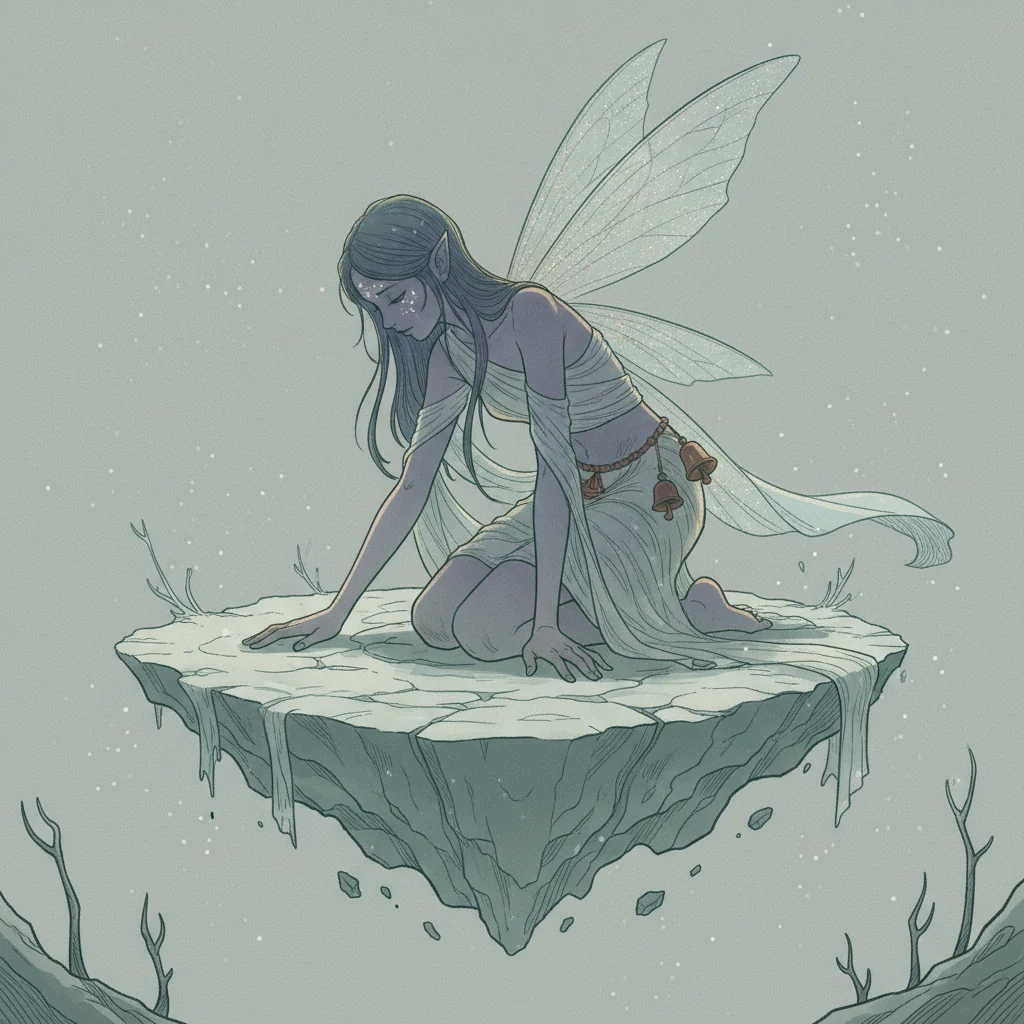
Past the moss beds and the last of the Vastra mooring-posts, the pools thin out, the lampmoss gives way to bare black ground, and the province becomes what visitors think all of it is: open dark under the whole turning sky. The Memoria live there — hermits, aurora-readers, small wandering households, and the ordinance-keepers of Sableholt, the one hold in the Kingdom where nothing is permitted to glow — and they are the mystics that even other Wisps find quiet.
They are also the keepers of the race's central custom. Every new Wisp, wherever they metamorphose, is brought out onto the flats for their first clear night, and it is a Memoria walker who leads them, waits with them, and says nothing until they speak — because the custom holds that the sky asks the question and the walker is only there to keep the owls off. Four centuries of first sentences sit in Lumenhal's archive. Every one of them was heard first by a Memoria ear, standing in the dark, at a respectful distance.
The Flats
The flats are distance, cold, and information. Out past the settled shores there is no lampmoss haze, no bells, and no light but your own — which a Memoria walker learns to hood with glamour, the hardest working a Wisp can attempt, practiced here out of necessity until the flats-born do casually what Lumenhal considers a masterwork. In exchange the dark gives everything: aurora legible to the horizon, the owls' hunting lanes, the lureblooms' patient lies, and stars the observatory's stacked lenses flatten into data and a walker simply stands inside.
Their deepest art is the race's rarest one: reading the light still leaving a place. In the dark of the flats, where no new light drowns the old, a skilled Memoria reader can stand on bare ground and watch the recent past of it peel away — who crossed, what hunted, what the aurora did here three nights ago. The Observatory carefully does not teach this discipline. The Memoria carefully do not stop practicing it, and the two positions have coexisted politely for a very long time because Lumenhal needs somebody who can read a crime scene and would rather it be family.
And the flats are shared. The glowworm banks run further out than the maps admit, and the Bank Speakers — the province's uncounted night observers — are the Memoria' nearest neighbors, oldest co-observers, and most regular conversation. Walkers and Speakers have compared skies, bank to bank and night to night, for generations. Which is why the Memoria were not surprised to learn the Speakers' parallel record agrees with Lumenhal's, and why, unlike the two astronomers who have understood what that means, the Memoria have understood it the whole time and simply seen no reason to alarm anyone.
Ways
The leading-out. The arrival custom, from the walker's side: fetch the new Wisp, walk them past the last light, stand off, and wait — an hour or a week, in silence, however long the first sentence takes. Walkers train for it the way soldiers train, because the flats at night are owls, lures, and cold, and the newcomer must never know they were in danger. A walker who has led out a hundred arrivals is owed courtesy in every hall in the province, and can be identified by how little they say about it.
The hooding. The discipline of going dark: hooding one's own light by glamour, first for the hunt-lanes and the lureblooms, eventually for its own sake. A hooded walker on the flats is the closest a Wisp comes to privacy, and the custom's one law is absolute — you do not ask what someone did while hooded, and you do not hood to another Wisp's harm. Sableholt's blackout ordinance is the custom scaled up to a town.
The neighboring. Every Memoria household keeps a standing acquaintance with a glowworm bank — skies compared, warnings traded, the banks' notation learned as a matter of ordinary politeness. It is the only place in the Kingdom where Faeries routinely study under Low-Brood observers, and the Memoria have never mentioned this to the court for the same reason they never mention anything to the court.
Relations
The Memoria hold the Lumina in real affection, salted with the amusement of field hands for people who read the sky through nine lenses from inside a heated building — they log their hours by letter, calibrate Lumenhal's instruments against their own eyes, and are the wing of the race that finds the four-century agony over publication strange, since in their experience the sky was never a secret and the flats never signed anything. The Vastra are their supply line and their post office, moss and news at the last mooring-posts on a schedule kept faithfully for centuries, and the two tribes share the settled opinion that Lumenhal would starve in a week without either of them.
The court does not know they exist as a distinct people, which is the correct amount. But the province knows this: Vesperine checks the banks' record against her own, the banks' record was co-kept at Memoria firesides, and if the Sealed Hand ever moves against the Speakers, it will discover that sixty thousand of the quietest people in the Kingdom regard the glowworms as neighbors — and that the flats at night belong to those who can read them.
Playing One
- You read the past off the ground. The light still leaving a place is yours to see — the party's answer to what happened here, strongest exactly where it is darkest.
- You can go dark. The hooding makes you the one Wisp who can hide, and the discipline behind it makes you hard to startle, hurry, or bluff.
- The wild dark is your home terrain. Owls, lures, aurora, cold: what kills travelers is, to you, weather with habits.
- A starting complication: the Bank Speaker your family has neighbored for three generations has asked you — not Lumenhal, you — to carry their record somewhere safe, because the banks have noticed the Sealed Hand counting them.