The Cherufe
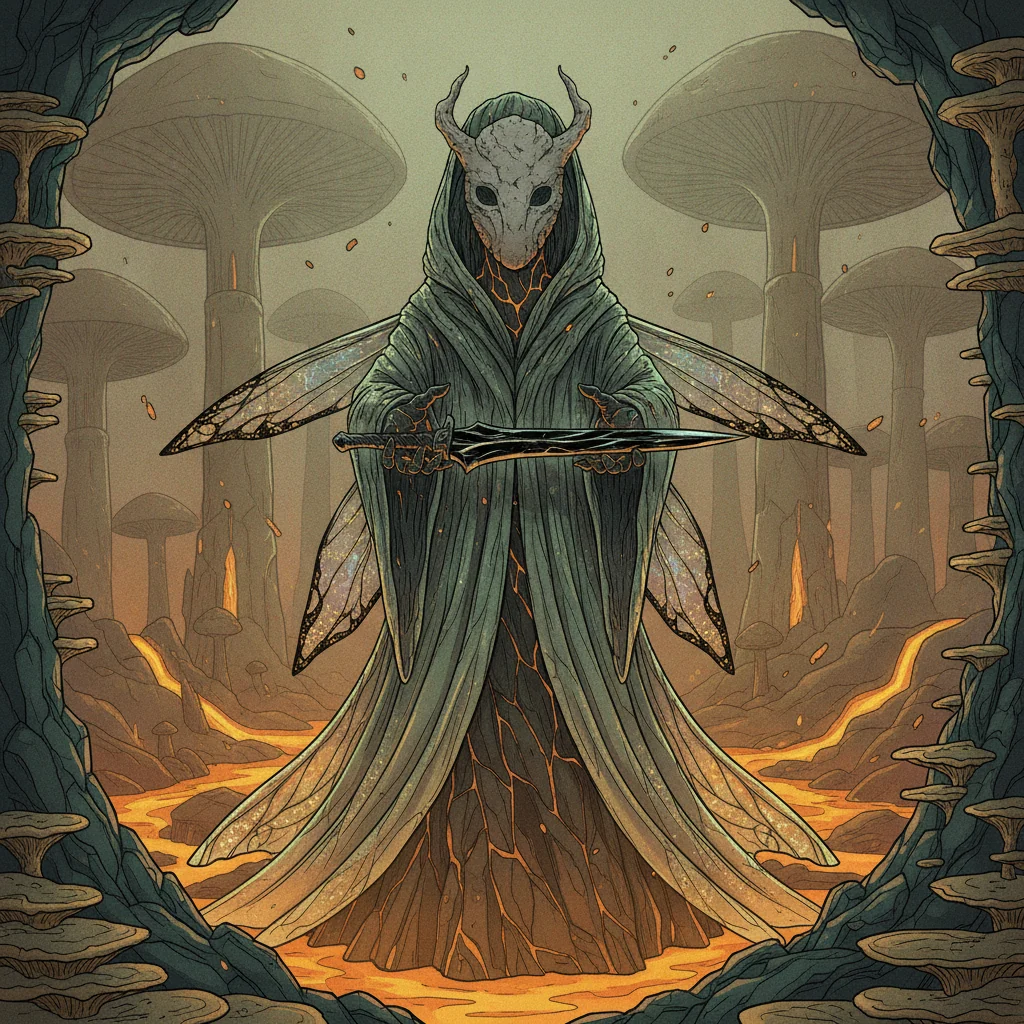
The Cherufe are the Salamanders of the country no hold can stand in: bands of a few dozen who follow the vent-fields and the ash-flats, set the burns the emberthorn fruits after, harvest, guide, and move on before the ground changes its mind. They hold no springs and swear to none, which by Boitatá law makes them nobody — and which the Cherufe regard as the whole point, there being no cheaper way to leave a war than to own nothing it is fought over.
Their mastery is the one the main entry calls the subtle application: heat removal. Any Salamander burns; an Cherufe un-burns — pulls the warmth out of a column of air, a stretch of glass, a dying traveler's fever — and in a desert that kills from both ends of the day, that is worth more than any weapon ever forged. It is the reason a band can sleep on the black fields and cross open ground at noon, and it is not taught to outsiders. It has never even been offered.
The Walk
The deep sand is not crossed, and the Cherufe do not cross it either — they walk its rim, which no one else can do, because the rim is where the vents are and the vents are theirs. A band's route is a decades-long circuit of burns set and harvests owed, navigated by vent-sequence the way a plainsman navigates by windmill, and an Cherufe elder can stand on cooling ash and tell you what the field will do for thirty years, which is why Shadecanyon's holds have started paying them for the kind of survey the Kingdom's Legation never answered.
At night, on the rim, the sand carries sound. What it carries is the Deep Song — the sand-swimmers sing through the ground, and have always sung, and the Cherufe, camped above it for generations with nothing to do but listen, are the "few Salamanders" who finally learned the language. This is not a curiosity. It means the Cherufe know what the founding actually was: not a heroic conquest but an eviction of a people who were never beaten, only inconvenienced — who need no springs, having been shaped to drink from the sand itself — and who are still down there, in numbers the Boitatá estimate at a few thousand and the songs count rather differently. Cherufe children learn the founding twice, once at any hold's fire and once in the other language, and grow up bilingual in history.
Two Salamanders alive know where the Sung Water is. One holds the Kiln. The other walks with an Cherufe band, and the bands do not speak of it, on the reasoning that some knowledge is a heat source, and the tribe's whole craft is knowing what to take the heat out of.
Ways
The cold-share. Warmth drawn off the camp at dusk, banked in the sand, and returned in the killing hours before dawn — given freely, to guests, to strangers found dying of the wrong half of the day, even to enemies, because in the deep desert withholding cold and cutting water are the same crime. Given as an act, never as a lesson: what is shared is the night's survival, not the craft.
Way-burns. The burns are set on the band's circuit, upwind of whichever holds have paid in harvest-shares, and an Cherufe's earned name almost always comes off the walk — a burn timed right, a crossing made, a band brought through a glass storm on a ninety-second warning. The holds call the names strange. The Cherufe note that Vashruk is a name earned by cutting water, and let the comparison sit.
The quiet answer. Asked what is under the sand, an Cherufe answers truthfully, once, in few words, and is not believed, and does not repeat it. The custom is old enough to have a shape: you owe the truth, you do not owe the argument. Lately the Deep Song has begun surfacing at springs and saying it themselves, and the holds have started asking Cherufe whether it is true, and the quiet answer has never had a larger audience or a worse reception.
Relations
The Boitatá hire them, feed them, respect the craft, and disbelieve the answer — a working relationship built on exactly one unaskable question. The Ifrit trust them with caravans across the open fields and pay in goods and silence, and the two tribes' dealings are the most frictionless in the province, being between the people who own nothing and the people who sell to everyone. The Kingdom does not know the Cherufe exist as a tribe: the Legation's census files them under whichever holds they trade through, and its map marks the deep desert empty — which is two errors, and the second one is the province's future. When the Deep Song decided to surface, they surfaced first at Cherufe fires, to learn which Salamanders would listen. The answer they took back down is part of why they are still coming up.
Playing One
- You can make cold in a burning world. Crossings at noon, sleep on open glass, a life saved from fever or nightcold most days you travel — worth more than any weapon in the party, and you know better than to sell it.
- You read ground the way others read faces. Vents, ash, sand-slope, the ninety-second smell of a glass storm: you know what the land will do next, and terrain fights on your side.
- You speak the language. You are one of the few Faeries alive who can talk with the sand-swimmers, and every side of the province's real question — including the sides that do not know it is a question yet — will eventually need you.
- A starting complication: a Deep Song singer you have known since childhood has asked you to carry the claim — the true one, to the whole province — up to whoever holds the Kiln, and to translate it honestly, and you know exactly how honesty will be received.