The Ifrit
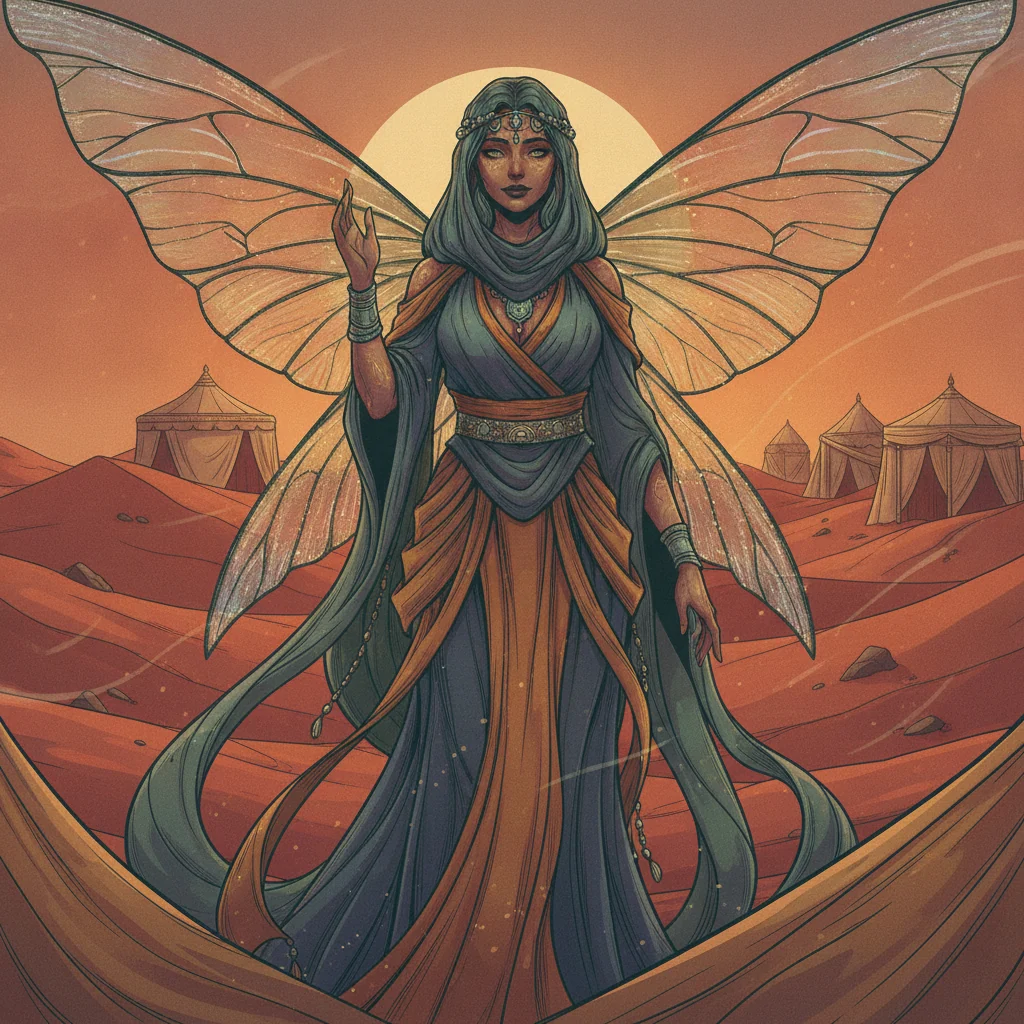
Gliding across the crimson dunes and cracked clay flats of the Red Sands, the Ifrit are proud nomads whose skin glows with the banked embers of smokeless fire. They swathe themselves in indigo, saffron and ochre silk to shield glistening dragon-scaled wings from the desert wind, and they navigate a trackless country by star-path, geometric rune and the counsel of desert spirits.
The Caravans
They travel in resilient caravans mounted on giant burrowing darkling beetles, moving between hidden moisture traps and ancient stone circles by routes held in memory and taught in verse. A caravan is a political unit as much as a household: it negotiates, contracts, and carries its own law.
Their sorcery is subtle and meditative rather than destructive — heat shimmer bent into concealment, dry wind called and dismissed, protective talismans worked in glass and silver. They trade mystical glass-craft and desert wisdom with those they judge worthy, and the judging is not a formality.
The Desert Rose
Their leader is a sorceress of such charisma and reach that the comparison to the Queen is made openly in the Emberwaste and nervously everywhere else. The Vermilion Court, her oasis-fortress, sits on the southern rim of the Red Sands facing the Bloodmoors — sited, deliberately and visibly, at the threat rather than at the capital.
It is commonly held that were it not for the standing goblin danger out of the Bloodmoors, the Desert Rose would already have moved on the throne. It is less commonly asked whether the threat is the reason or the excuse, and it is not asked at all inside the Court.
Ways
Fiercely defensive of their oasis sanctuaries and scrupulously generous within them: an Ifrit camp will feed and water a stranger without question and expect them gone by the second evening.
They regard the Cherufe as kin who went indoors and the Boitatá as kin who took a job. Both descriptions are affectionate. Neither is a compliment.