Gnome
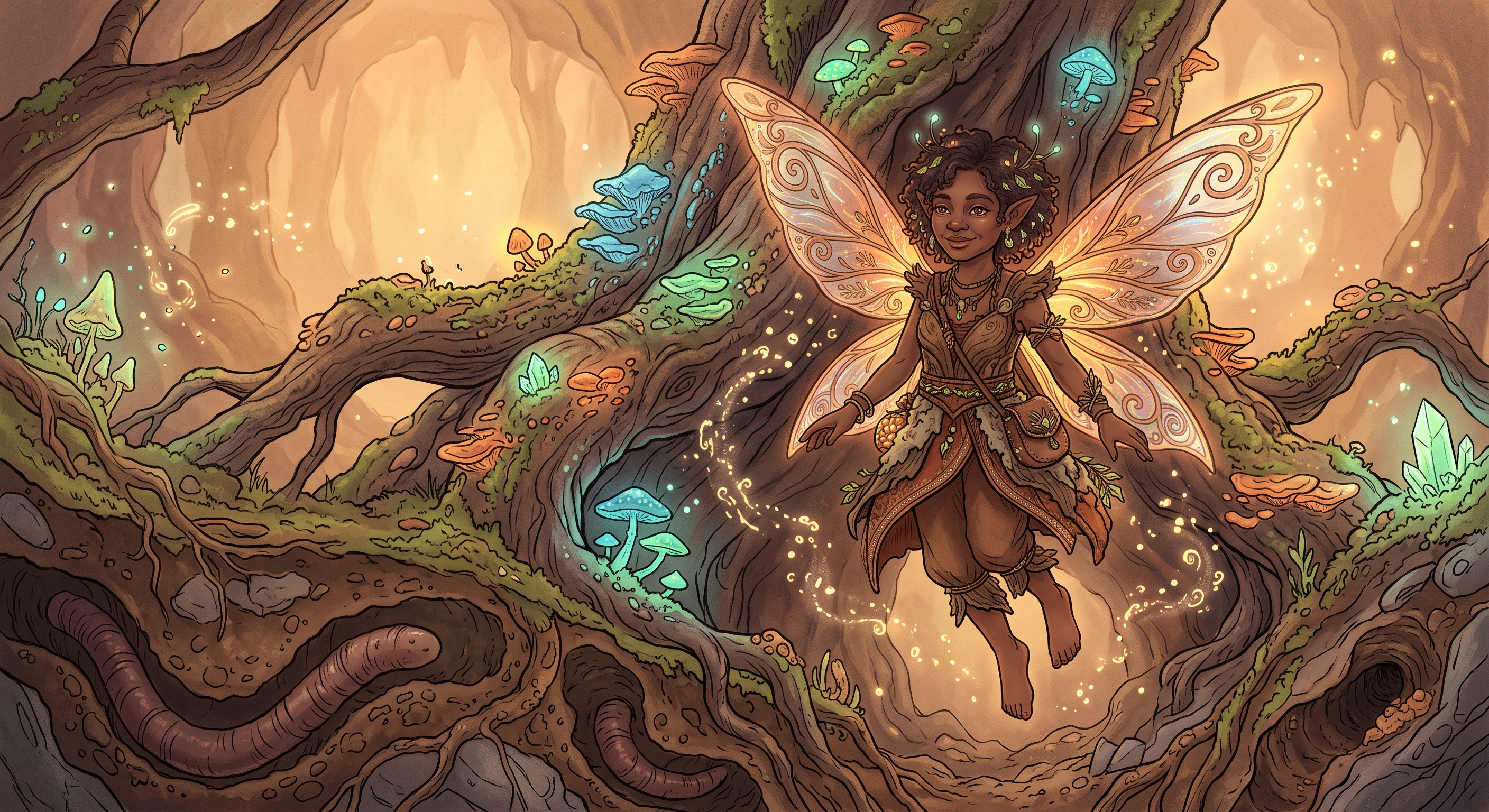
Dark-skinned, broad, and deeply magical, the Gnomes hold the lightless immensity beneath a third of the Kingdom. They live in family hollows packed hundreds deep — siblings, children, elders, and pets in one warm stone room after another — and they have never produced a king, a duke, or a governor. The Kingdom has tried to install one several times. Each attempt has been received with great courtesy and quietly absorbed.
What the Gnomes have instead is the Motherstone: a cathedral-sized geode at the confluence of the deep waterways, resonant enough that words spoken at its heart carry to every clan-hollow linked to the stone. Clans send elders there to argue, trade, and reconcile.
Appearance
Stocky and strong, with skin in deep browns and slate greys and eyes adapted to near-total darkness. Their wings are short and broad and almost never unfurled — there is nowhere underground worth flying — which the court cites as evidence of a race in decline and the Gnomes consider a sensible response to having a ceiling.
Gnome eyes are the best in the Kingdom below ground and the worst above it. A Gnome on a bright Meadowlands day is functionally squinting through the entire visit, which explains a good deal about Gnomish opinions of the capital.
Attuned Magic
Earth. A nascent Gnome works stone like clay and forges sand into sandstone by hand. A powerful one shakes the ground, opens rifts, raises walls, and animates golems out of raw rock. Gnome earth-magic is the most practical craft in the Kingdom and the least admired, on the grounds that it produces useful things rather than beautiful ones.
Its everyday form is structural: a gallery is sung into stability rather than propped, and a hollow's safety depends on a handful of elders who can hear a settling before it becomes a collapse. This is why Gnomes are the only people in either realm who treat listening as a technical qualification.
Life
A hollow is one extended family, hundreds strong, in a chain of warm stone rooms with the taproots of the Greenmantle running through them. Work is fungus, root-sugar, grub-pens, stone, and freight. Nothing is private and nobody minds — Gnomish notions of solitude begin at about eleven people in the room.
Names. Given name, hearth, and clan: Dunnowar of the Ninth Hearth. The hearth is where you were taken in, not where you came from, which is the whole of Gnome social theory in one convention.
Arrival. A new-metamorphosed Gnome is claimed. Whichever hollow finds them takes them in as kin, immediately and without formality, and the taking is permanent — a Gnome adopted at arrival is not like family, they are family, with inheritance and obligation attached. Every Gnome in the Hollows arrived this way, which is why the custom is defended with such force.
Knock-code. Taught before speech. Every child learns which knock carries along which taproot and how far, and a Gnome who cannot signal is considered not fully raised.
Society
Clan first, always. A Gnome's obligations run to their hollow, then to the neighboring hollows, then — distantly and grudgingly — to the Kingdom. Property is held in common within a hollow and disputes are settled by elders who have known both parties since their metamorphosis.
The Motherstone moot is the one formal body in the Kingdom where non-Faeries hold seats. Moles, worms, and beetles send speakers, and their voices carry the same weight as any clan's. The Eternal City regards this as an embarrassing provincial eccentricity. The Gnomes regard it as none of the Queen's business.
Tribes
Three lobes of one country, joined by a few long tunnels and very little agreement.
- The Hearthkin (~420,000) tap the living roots in the Roots, and trade their yield to the surface.
- The Deepfarers (~340,000) work the Mines beneath the Heartland for ore and gems, on shifts, under discipline.
- The Sullen (~140,000) carve bone and chitin into art in Sorrowloom, beneath the Twilight Forest.
The Tappers fill a room, the Deepfarers run a shift, and the Sullen hand you the finished thing without comment.
Currents
The Hearths. Nine great clan-clusters and some two hundred lesser ones, jealous of their galleries and united only by a sincere refusal to have a king.
The Moot-Speakers. Elders, Gnome and otherwise. The Basekin speakers are not a bloc, do not vote together, and have been effective for so long that the Kingdom's assumption they are decorative is now their best asset.
The Assay Office. The Crown's surveyors, tasked with mapping and taxing the Hollows for two centuries and about a fifth done. Its staff are mostly Gnomes now and its maps are mostly wrong on purpose.
The Quiet Descent. Gnomes and kobolds who have stopped pretending, and argue openly for a union of the underground against both surface crowns. Small, young, and taken seriously only by the Chancery, which has a very thick file.
Relations
Genuinely good with the underground non-Faerie races, which is rare enough to be politically significant. At their lowest reaches the Hollows run into the Kobold Deepworks, and the two peoples have been trading, intermarrying by metamorphosis, and lying to their respective authorities about it for a very long time.
Playing One
- You are the party's engineer. Walls, shelter, tunnels, and the certainty that the roof will hold. Nothing you do is subtle and all of it is load-bearing.
- You have three hundred relatives. Somewhere in every underground place there is someone who will feed you and expect to be asked about their hollow first.
- Above ground you are half-blind and conspicuous. The Hollows are your competence; the meadow is somebody else's.
- A starting complication: your hearth adopted a Basekin speaker as kin, the Assay Office has ruled it void, and your clan has asked you to go argue it somewhere they cannot be blamed for.